
Mesh vs Non-Mesh Hernia Repair: Which Is Better for Long-Term Relief in Chennai?

If you have been diagnosed with a hernia, one of the first questions that comes to mind is simple: should you choose mesh repair or non-mesh repair?

It is a valid concern because hernia surgery is not just about fixing the bulge. It is about preventing recurrence, reducing pain, ensuring faster recovery, and helping you return to normal life without fear of the problem coming back.

Many patients searching for the best hernia repair in Chennai often feel confused by conflicting advice. Some hear that mesh repair is the gold standard. Others worry about complications and look for non-mesh options. The truth is, the right choice depends on your condition, the type of hernia, your medical history, and most importantly, the expertise of your surgeon.

For Dr Kumar at Billroth Hospitals, every hernia case is approached with precision and personal attention. As a leading hernia surgeon Dr Kumar known for advanced laparoscopic and robotic procedures, focuses on long-term relief rather than temporary solutions.

Let us understand the real difference between mesh and non-mesh hernia repair and which option may be better for you.

Understanding Hernia Repair

A hernia happens when an internal organ or tissue pushes through a weak area in the muscle wall. Common types include inguinal hernia, umbilical hernia, incisional hernia, and ventral hernia.

The goal of surgery is to push the tissue back into place and strengthen the weakened area so the hernia does not return.

This repair is usually done through three main approaches:

1. Laparoscopic Hernia Repair

This is a minimally invasive technique performed using small cuts, a camera, and specialized instruments. Recovery is faster, pain is less, and patients return to work sooner.

Dr Kumar hernia specialist most often recommends laparoscopic hernia  repair for suitable patients because of its precision and excellent recovery outcomes.

2. Robotic Hernia Repair

Robotic surgery is one of the most advanced forms of hernia treatment available today. It offers better visualization, improved precision, and enhanced control during complex repairs.

For recurrent hernias, large abdominal wall defects,  difficult and Complex Hernias , Dr Kumar hernia surgeon often prefers robotic repair because it allows highly accurate reconstruction with excellent long-term results.

3. Open Hernia Repair

This is the traditional method involving a larger incision. It may still be needed in specific situations, especially for very large hernias or patients who are not suitable for minimally invasive surgery.

While open surgery has its place, Dr Kumar hernia specialist generally prioritizes laparoscopic and robotic approaches whenever clinically appropriate.

What Is Mesh Hernia Repair?

Mesh repair involves placing a surgical mesh over or under the weak muscle area to provide added strength and support.

The mesh acts like reinforcement, helping the tissue heal stronger and reducing the chance of recurrence.

This method is commonly used in:

>> Inguinal hernia

>> Incisional hernia

>> Ventral hernia

>> Recurrent hernia

>> Large abdominal wall defects

In laparoscopic and robotic hernia surgeries, mesh placement is often the preferred approach because it offers better durability.

What Is Non-Mesh Hernia Repair?

Non-mesh repair, also called tissue repair, uses the patient’s own muscle and tissue to close the defect without placing synthetic material.

This method may be considered for:

>> Very small hernias

>> Selected young patients

>> Cases where mesh placement is not ideal

>> Patients with specific concerns about implants

While non-mesh repair may sound simpler, it is not always the best option for long-term relief.
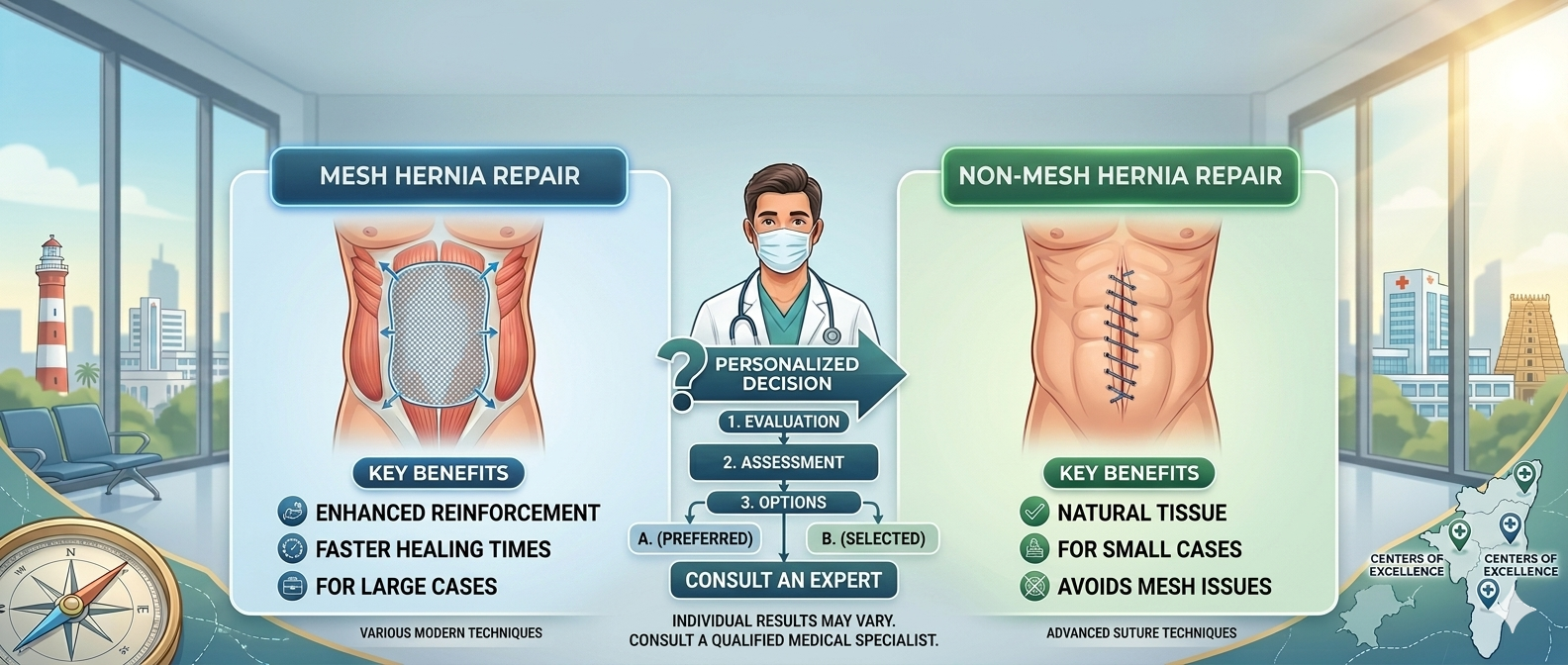
Mesh vs Non-Mesh Repair

Mesh vs Non-Mesh Repair: Which Gives Better Long-Term Results?

This is where patients need honest and expert guidance.

Recurrence Rate

One of the biggest concerns after hernia surgery is recurrence.

Mesh repair generally has a lower recurrence rate compared to non-mesh repair, especially in moderate to large hernias.

This is why Dr Kumar hernia surgeon often recommends mesh-based laparoscopic or robotic surgery for patients who want durable, long-term results.

Non-mesh repair may work well in selected cases, but the risk of recurrence can be higher if the tissue repair is under tension.

Recovery Time

Laparoscopic and robotic mesh repairs usually allow faster recovery compared to open tissue repair.

Patients often experience:

>> Less pain

>> Smaller scars

>> Shorter hospital stay

>> Earlier return to work

This makes mesh repair highly preferred among working professionals and active individuals in Chennai.

Post-Surgical Comfort

Modern surgical mesh technology has improved significantly.

When performed by an experienced  hernia specialist like Dr Kumar, patients generally tolerate mesh very well with excellent comfort and low complication rates.

Problems often arise not because of the mesh itself, but because of poor surgical technique or improper case selection.

Suitability for Complex Hernias

For recurrent hernias, incisional hernias, and abdominal wall reconstruction, mesh repair is often essential.

In such cases, robotic surgery provides outstanding precision and strength, making it a preferred option under the care of Dr Kumar hernia surgeon.

Common Myths About Mesh Repair

Myth 1: Mesh Always Causes Complications

This is one of the biggest misconceptions.

Modern mesh materials are safe, biocompatible, and widely used worldwide. Complications are rare when surgery is done correctly.

The key factor is surgeon expertise, not fear of mesh itself.

Myth 2: Non-Mesh Repair Is Always Better

Not true.

Choosing non-mesh repair for a large hernia may increase the risk of recurrence and repeat surgery later.

The best repair is not the one without mesh. It is the one that gives you lasting relief.

Myth 3: Open Surgery Is the Only Reliable Option

Many patients still believe bigger surgery means better surgery.

In reality, laparoscopic and robotic mesh repair often provide better precision and faster healing with equally strong or better long-term outcomes.

When Does Dr Kumar Recommend Robotic Hernia Repair?

As a highly experienced Dr Kumar hernia surgeon, robotic surgery is often preferred for:

>> Recurrent hernias

>> Complex ventral hernias

>> Large incisional hernias

>> Abdominal wall reconstruction

>> Bilateral inguinal hernias

>> Patients seeking faster recovery with less pain

Robotic surgery offers better control in delicate areas and helps create stronger repairs with reduced tissue trauma.

This is especially valuable when long-term success matters most.

How to Decide the Right Hernia Repair for You

There is no one-size-fits-all answer.

The decision depends on:

>> Type of hernia

>> Size of the defect

>> Whether it is a first-time or recurrent hernia

>> Your age and lifestyle

>> Previous surgeries

>> Overall health condition

>> Surgeon’s expertise

This is why choosing the right specialist matters more than simply choosing mesh or non-mesh.

At Dr Kumar at Billroth Hospitals, the focus is always on personalized treatment planning.

Every patient is evaluated carefully before deciding whether laparoscopic, robotic, or open surgery is the right approach.

Why Chennai Patients Trust Dr Kumar Hernia Specialist

Patients today are not just looking for surgery. They are looking for confidence.

They want a surgeon who understands advanced techniques, explains options clearly, and focuses on long-term outcomes.

That is why many patients searching for the best hernia repair in Chennai choose Dr Kumar hernia surgeon for treatment.

With strong expertise in laparoscopic and robotic hernia surgery, Dr Kumar combines surgical precision with patient-centered care.

Whether it is a simple inguinal hernia or a complex recurrent abdominal wall repair, the goal remains the same: safe surgery and lasting relief.

Final Verdict: Mesh or Non-Mesh?

For most patients, especially those with moderate to large hernias, recurrent hernias, or abdominal wall defects, mesh repair offers better long-term relief.

When combined with laparoscopic or robotic surgery, the benefits become even stronger:

>> Lower recurrence

>> Faster recovery

>> Less pain

>> Better strength

>> Improved quality of life

Non-mesh repair still has a role in carefully selected cases, but it should be chosen based on medical need, not fear or myths.

The right answer is not simply mesh or non-mesh.

The right answer is the right surgery, performed by the right surgeon.

If you are considering hernia treatment and want expert guidance from a trusted Dr Kumar hernia specialist, choosing advanced laparoscopic and robotic care can make all the difference.

Because with hernia surgery, the goal is not just repair.

It is peace of mind for years to come.

FAQs

  1. Is mesh hernia repair better than non-mesh repair?

Mesh hernia repair is often better for moderate to large hernias because it reduces recurrence and provides stronger long-term support. Dr Kumar hernia surgeon recommends mesh repair in many cases for lasting relief.

  1. When is non-mesh hernia repair recommended?

Non-mesh repair may be suitable for very small hernias, selected young patients, or cases where mesh placement is not ideal. The decision depends on the patient’s condition and surgical evaluation.

  1. Is robotic hernia surgery better than open surgery?

Robotic hernia surgery offers better precision, smaller incisions, less pain, and faster recovery compared to open surgery in many cases. Dr Kumar hernia specialist often prefers robotic repair for complex and recurrent hernias.

  1. Does hernia mesh cause complications?

Modern surgical mesh is generally safe and widely used. Complications are uncommon when surgery is performed by an experienced surgeon like Dr Kumar hernia specialist using proper technique.

  1. Who provides the best hernia repair in Chennai?

Patients looking for the best hernia repair in Chennai often choose Dr Kumar at Billroth Hospitals for advanced laparoscopic and robotic hernia surgery focused on long-term success.

Why Recurrent Hernia Treatment in Chennai Needs Advanced Surgical Care

A hernia coming back after surgery can be frustrating, painful, and emotionally exhausting. Many patients believe that once a hernia is repaired, the problem is gone forever. Unfortunately, that is not always the case. Recurrent hernias are more common than many people realize, and treating them requires far more precision than the first surgery.

When a hernia returns, the condition becomes more complex. Scar tissue, previous mesh placement, weakened abdominal muscles, and underlying health conditions all make repeat surgery more challenging. This is why recurrent hernia treatment in Chennai should never be approached like a routine first-time repair.

For patients looking for lasting relief, advanced surgical care from an experienced Hernia specialist like Dr Kumar at Billroth Hospitals becomes essential. As a leading laparoscopic and robotic hernia surgeon, Dr Kumar focuses on complex and recurrent hernia repairs using modern techniques designed for safer recovery and better long-term outcomes.

Let us understand why recurrent hernias demand a different level of care and why choosing the right surgeon matters.

What Is a Recurrent Hernia?

A recurrent hernia happens when a hernia returns after it has already been repaired through surgery. It may appear in the same location or very close to the original repair site.

This can happen in several types of hernias, including:

>> Inguinal hernia

>> Umbilical hernia

>> Incisional hernia

>>Ventral hernia

>> Hiatal hernia

Patients often notice a familiar bulge, discomfort while standing, pain during movement, or pressure in the abdomen. Some people ignore the early warning signs, assuming it is normal post-surgery discomfort. This delay can make treatment more difficult.

Dr Kumar hernia specialist often sees patients who come in months or even years after their first repair, only to discover that the hernia has silently returned.

Why Do Hernias Come Back?

A recurrent hernia does not always mean the first surgery failed. Several factors can contribute to recurrence.

Weak Tissue Strength

Some patients naturally have weaker connective tissues, making them more prone to repeat hernias.

Infection After Previous Surgery

Post-surgical infections can weaken the repair area and increase recurrence risk.

Poor Mesh Placement

Incorrect mesh positioning or poor fixation may lead to failure over time.

Obesity and Diabetes

Excess abdominal pressure and delayed healing can affect repair strength.

Heavy Lifting Too Soon

Returning to physical strain before proper healing is complete can reopen the weakness.

Smoking

Smoking reduces blood supply and slows tissue healing.

Complex Hernia Anatomy

Large hernias, multiple previous surgeries, and scar tissue increase surgical difficulty.

This is exactly why recurrent hernia treatment in Chennai needs an advanced and personalized approach rather than a standard repair.

Why Recurrent Hernia Surgery Is More Complex

First-time hernia surgery is often straightforward. Recurrent hernia surgery is not.

The surgeon must deal with:

>> Previous scar tissue

>> Existing surgical mesh

>> Distorted anatomy

>> Higher risk of bowel injury

>> Increased infection risk

>> Reduced tissue strength

This requires careful planning and high surgical expertise.

Dr Kumar hernia surgeon approaches every recurrent hernia case with detailed imaging, proper evaluation, and a customized treatment plan. There is no one-size-fits-all solution in repeat hernia surgery.

That is where advanced surgical care makes the difference.

Surgical Options for Recurrent Hernia Treatment

There are three major approaches used for recurrent hernia treatment in Chennai:

>> Laparoscopic Surgery

>> Robotic Surgery

>> Open Surgery

The right method depends on the size, location, complexity, and previous repair history.

Since Dr Kumar is primarily a laparoscopic and robotic surgeon, special emphasis is placed on minimally invasive solutions whenever possible.

Laparoscopic Surgery for Recurrent Hernia

Laparoscopic hernia repair is one of the most preferred approaches for recurrent cases, especially when the first surgery was done using an open method.

This procedure uses small cuts, a camera, and specialized instruments to repair the hernia from inside the abdomen.

Benefits of Laparoscopic Surgery

>> Smaller incisions

>> Less pain after surgery

>> Faster recovery

>> Reduced hospital stay

>> Lower infection risk

>> Better visualization of hidden defects

For many patients, laparoscopic repair offers a safer second chance after a failed previous surgery.

Dr Kumar hernia specialist uses advanced laparoscopic techniques such as eTEP and IPOM depending on the complexity of the case.

When does Dr Kumar use the eTEP technique?

The eTEP approach is especially useful for ventral and incisional recurrent hernias where mesh placement needs precision without entering the abdominal cavity directly. It helps reduce complications and improves abdominal wall strength.

Why Robotic Surgery Is Changing Recurrent Hernia Treatment

Robotic surgery has become one of the most advanced solutions for complex and recurrent hernia repair.

This is especially valuable when dealing with previous mesh repairs, difficult anatomy, or abdominal wall reconstruction.

Robotic surgery gives the surgeon greater precision, improved control, and enhanced 3D visualization.

Benefits of Robotic Hernia Surgery

>> Superior precision in difficult repairs

>> Better handling of scar tissue

>> Stronger abdominal wall reconstruction

>> Smaller cuts and less trauma

>> Faster healing

>> Reduced post-operative pain

>> Lower recurrence risk in selected cases

Dr Kumar robotic hernia surgeon uses robotic techniques for complex recurrent hernias where precision matters most. For patients who have undergone failed previous surgeries, robotic repair often provides better long-term strength and stability.

Many patients specifically seek Dr Kumar hernia surgeon because of his expertise in robotic abdominal wall reconstruction and advanced minimally invasive repair.

When Open Surgery Is Still Needed

While laparoscopic and robotic surgery are preferred whenever possible, some patients may still require open surgery.

This is usually considered when:

>> The hernia is extremely large

>> There are multiple previous failed repairs

>> There is severe infection

>> Mesh removal is necessary

>> Emergency complications like strangulation are present

>> Even in open surgery, experience matters enormously.

Dr Kumar hernia specialist carefully selects the safest approach for each patient rather than pushing one method for everyone.

The goal is always long-term success, not short-term convenience.

Why Choosing the Right Hernia Specialist Matters

Recurrent hernia treatment is not the place for guesswork.

Patients often focus only on hospital names, but outcomes depend more on the surgeon’s experience than the building itself.

That is why patients across Chennai trust Dr Kumar at Billroth Hospitals for advanced recurrent hernia repair.

As a dedicated Dr Kumar hernia surgeon with expertise in laparoscopic, robotic, and open approaches, he handles complex repeat surgeries with a focus on durable results.

What makes the difference?

>> Detailed pre-surgical evaluation

>> Expertise in advanced laparoscopic repair

>> Strong robotic surgery experience

>> Personalized surgical planning

>> Focus on preventing future recurrence

>> Safe recovery guidance after surgery

A specialist understands not just how to repair the hernia, but how to prevent it from returning again.

Recovery After Recurrent Hernia Surgery

Recovery depends on the surgical method used and the complexity of the repair.

Patients who undergo laparoscopic or robotic surgery usually recover faster than those who require open surgery.

Typical recovery includes:

>> Walking within 24 hours

>> Short hospital stay

>> Gradual return to normal activity

>> Avoiding heavy lifting for several weeks

>> Regular follow-up visits

Dr Kumar hernia specialist provides structured post-surgery guidance because recovery plays a major role in long-term success.

Ignoring recovery instructions is one of the major reasons hernias return again.

How to Prevent Another Hernia Recurrence

Even after successful surgery, prevention matters.

Patients should focus on:

>> Maintaining healthy body weight

>> Controlling diabetes

>> Avoiding smoking

>> Treating chronic cough

>> Managing constipation

>> Avoiding unnecessary heavy lifting

Following post-surgical restrictions properly

Dr Kumar hernia surgeon always emphasizes that surgery repairs the weakness, but lifestyle habits protect the repair.

Long-term success depends on both.

When Should You See a Specialist?

Do not ignore symptoms like:

>> A new bulge near old surgery site

>> Pain while standing or lifting

>> Pressure in the abdomen

>> Swelling after physical activity

>> Digestive discomfort with previous hernia history

>> Early diagnosis makes treatment simpler and safer.

Waiting too long can lead to complications such as bowel obstruction or strangulation, which may require emergency surgery.

If you suspect recurrence, consulting Dr Kumar hernia specialist early can prevent bigger problems later.

Final Thoughts

A recurrent hernia is not just a repeat problem. It is a more complex surgical challenge that requires advanced planning, modern technology, and the hands of an experienced specialist.

This is why recurrent hernia treatment in Chennai should focus on expertise, not just availability.

Laparoscopic surgery offers faster recovery. Robotic surgery provides greater precision for complex repairs. Open surgery remains important in selected difficult cases. Choosing the right method requires the judgment of a skilled surgeon.

Dr Kumar at Billroth Hospitals combines laparoscopic excellence, robotic precision, and years of experience in treating recurrent and complex hernias. For patients seeking lasting relief instead of temporary fixes, expert care becomes the smartest decision.

Because when a hernia comes back, your treatment should be stronger than the problem itself.

FAQs

  1. What is a recurrent hernia?

A recurrent hernia is a hernia that returns after a previous hernia surgery. It can happen in the same area due to weak tissue, mesh issues, infection, or lifestyle factors.

  1. Which surgery is best for recurrent hernia treatment in Chennai?

The best surgery depends on the type and complexity of the hernia. Dr Kumar hernia specialist often recommends laparoscopic or robotic surgery for better precision and faster recovery, while open surgery is used for more complex cases.

  1. Is robotic surgery better than laparoscopic surgery for recurrent hernias?

Robotic surgery offers better precision, improved 3D visualization, and stronger abdominal wall reconstruction in complex cases. Laparoscopic surgery is also highly effective and is often preferred for faster recovery and smaller incisions.

  1. How long does recovery take after recurrent hernia surgery?

Recovery varies based on the surgical method. Most laparoscopic and robotic surgery patients recover faster and return to normal activities within a few weeks, while open surgery may take longer.

  1. Why should I choose Dr Kumar for recurrent hernia treatment in Chennai?

Dr Kumar at Billroth Hospitals is an experienced laparoscopic and robotic hernia surgeon specializing in complex and recurrent hernia repairs, offering personalized treatment plans for long-term results.

Call Now Button