


A Paraumbilical Hernia is a type of hernia that occurs near the belly button (umbilicus). It develops near the umbilicus either above, below or directlu adjacent to the belly button (Umbilicus).
Often caused by increased pressure in the abdomen, which can be due to factors such as Obesity, pregnancy, heavy lifting or persistent coughing.
PARAUMBILICAL HERNIA is treated with LAPAROSCOPIC SURGERY which gives faster recovery, LAPAROSCOPIC PARAUMBILICAL HERNIA SURGERY involves pushing the herniated content back I to the abdomen and strengthening the Abdominal wall with stitches and placing a mesh over the defect.
LAPAROSCOPIC SURGERY gives very less pain and minimal scar
ROBOTIC PARA UMBILICAL HERNIA- Robotic approach can be utilized for some patients with Para Umbilical Hernia.DR KUMAR excels in Robotic Para Umbilical Hernia Surgery.
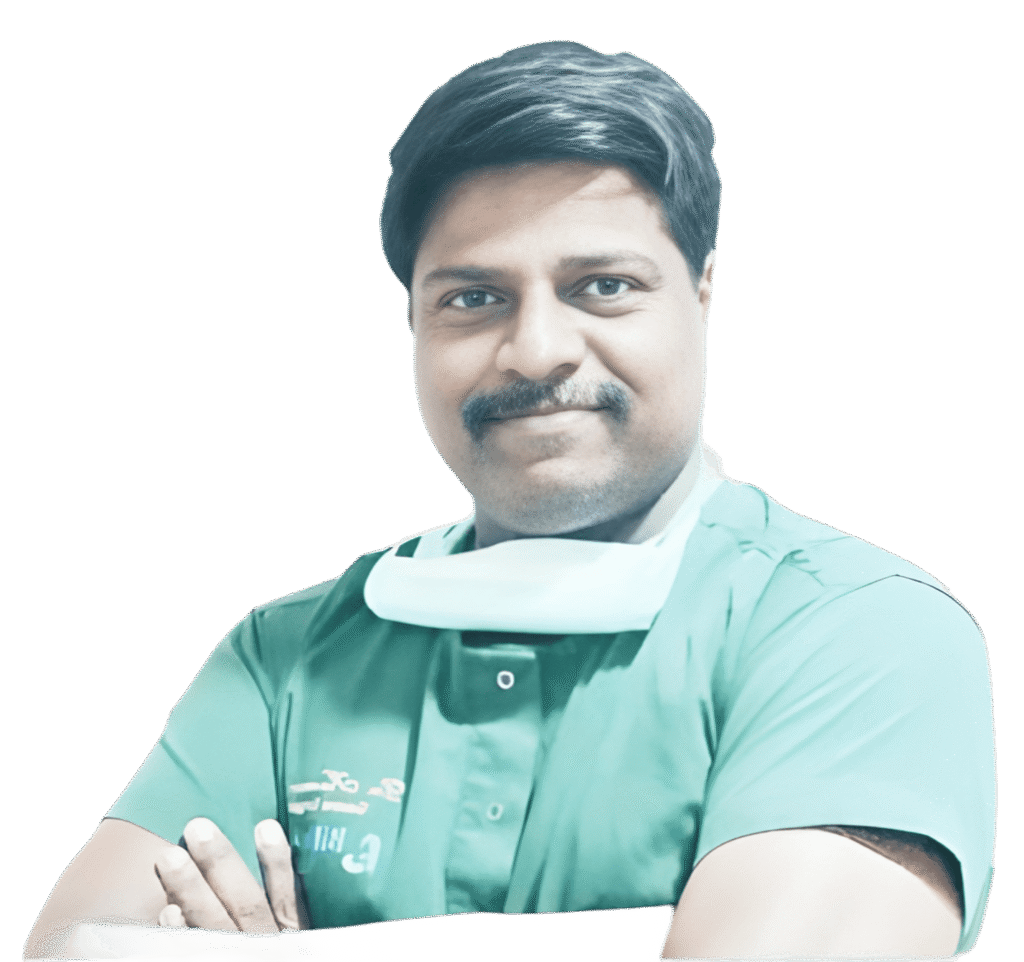
DR. KUMAR ( Billroth Hospital) has huge experience in PARAUMBILICAL HERNIA TREATMENT AND SURGERY especially LAPAROSCOPIC PARAUMBILICAL HERNIA SURGERY. With more than 29+ years of experience he can be consider as one of the Best Doctor for Paraumbilical Hernia treatment and widely recommended for Best Paraumbilical Hernia Treatment in Chennai and consider as one of the Best Paraumbilical hernia Doctor in Chennai with more than 29+ years of experience he is truly consider as PARAUMBILICAL HERNIA SPECIALIST and DR. KUMAR (Billroth Hospital) with all facilities can be consider as Best Hospital for Paraumbilical Hernia Treatment.
A paraumbilical hernia occurs when tissue or fat pushes through a weakness near the belly button, usually just beside the umbilicus. It may appear as a swelling around the navel area and can become more noticeable while coughing, standing, or straining. We evaluate the size, symptoms, and risk level before recommending treatment.
Symptoms may include swelling near the belly button, discomfort, pain while coughing or lifting, heaviness around the abdomen, or a bulge that increases with strain. Some patients may have no pain initially, but the hernia can enlarge over time. We advise early evaluation if you notice a swelling around the navel area.
A paraumbilical hernia may develop due to weakness in the abdominal wall. Risk factors can include obesity, pregnancy, heavy lifting, chronic cough, constipation, previous abdominal surgery, or repeated strain on the abdomen. We assess the underlying cause because reducing pressure on the abdomen is important even after repair.
A true paraumbilical hernia usually does not close on its own in adults. Small and painless hernias may sometimes be observed for a period, but surgery is commonly recommended when the hernia causes pain, grows in size, or carries a risk of obstruction or strangulation. We advise based on examination and patient condition.
You should seek urgent care if the swelling becomes painful, hard, red, irreducible, or is associated with vomiting, fever, abdominal distension, or inability to pass stools. These may suggest obstruction or strangulation, which can be serious. We recommend not delaying consultation if the hernia becomes suddenly painful.
We provide laparoscopic, robotic, and open repair options depending on hernia size, patient fitness, previous surgeries, and abdominal wall condition. Mesh repair may be recommended in many adult cases to reduce recurrence risk. The treatment plan is personalised after proper examination and diagnosis.
Yes, laparoscopic repair may be possible for suitable paraumbilical hernia patients. It uses small incisions and a camera-guided approach to repair the defect. In selected patients, it may reduce wound complications, pain, and recovery time. However, open surgery may still be better for certain large or complex hernias.
Mesh is often used in adult paraumbilical hernia repair to strengthen the abdominal wall and reduce recurrence. The need for mesh depends on hernia size, tissue strength, patient health, and recurrence risk. We explain the advantages, concerns, and alternatives before surgery so patients can make an informed decision.
Recovery depends on the surgical approach and hernia size. Many patients can walk soon after surgery and gradually return to routine activities. Heavy lifting, abdominal strain, and intense exercise are usually restricted for some time. We provide clear post-operative guidance, wound care instructions, and follow-up support.
We provide expert evaluation and treatment for paraumbilical hernia at Dr Kumar at Billroth Hospitals. The page focuses on symptoms, causes, and treatment options for paraumbilical hernia with surgical care. Our approach combines proper diagnosis, modern surgical techniques, patient safety, and personalised recovery planning.
Dr Kumar at Billroth Hospitals, Chennai is one of the Best Hernia Doctors and Gallbladder Stone Specialists with 29+ years of experience.
DrKumar – Billroth Hospitals | Hernia & Gallbladder Specialist | Laparoscopic & Robotic Surgeon in Chennai © 2026 All Rights Reserved