Daycare Hernia Surgery: Procedure, Benefits, Cost & Recovery Timeline (Complete Patient Guide)

If you have been living with a hernia, you already know how it quietly shapes your day. A dull pull while standing, a visible bulge that appears after meals, discomfort that makes workouts, travel, or even long office hours feel harder than they should. The good news is that hernia treatment has changed dramatically in the last decade. Today, many patients can get treated and go home the same day, safely and comfortably.

This guide explains Daycare Hernia Surgery in plain language: how the procedure works, who it is for, what benefits you can expect, the real factors that influence price, and a recovery timeline that helps you plan your work and family routine.

At Dr Kumar Billroth Hospitals, our aim is simple: give you clinically sound hernia care with the convenience of modern daycare protocols, clear communication, and a recovery plan that fits real life.

Daycare hernia surgery procedure

What is Daycare Hernia Surgery?

Daycare Hernia Surgery (also called same day hernia surgery) means you are admitted, operated, observed, and discharged within a few hours, typically on the same day. It is not “rushed surgery.” It is a structured, safety-first pathway designed for patients who are stable and suitable candidates.

Most common hernias treated through daycare protocols include:

>> Inguinal hernia (groin hernia, common in men)
>> Umbilical hernia (near the belly button)
>> Incisional hernia (at a previous surgery scar)
>> Femoral hernia (more common in women, lower groin)
>> Small ventral hernias (front abdominal wall)

Daycare surgery is possible because techniques are less invasive, anesthesia is smoother, pain control is better, and early mobilization is encouraged.

Why Do People Choose Daycare Hernia Surgery Now

Patients do not just want surgery. They want minimal disruption. A daycare pathway is popular because it is built around the patient’s daily routine.

Here is what that usually looks like:

>> You come in on the day of surgery
>> A planned, standardized operation is done
>> You recover under monitoring
>> You walk, eat light, pass urine, and meet discharge milestones
>> You go home with medicines and a clear recovery plan

This approach is widely used for appropriate hernia cases and helps patients return to normal life faster.

Who is the Right Candidate for Daycare Hernia Surgery?

Many patients qualify, but suitability is decided after clinical evaluation. You may be a good candidate if:

>> The hernia is uncomplicated (not strangulated or obstructed)
>> You do not have unstable heart or lung disease
>> Your diabetes and blood pressure are reasonably controlled
>> You can arrange a responsible adult to accompany you home
>> You can follow post-op instructions and return for review

You may need longer observation or admission if:

>> The hernia is large or complex
>> You have severe sleep apnea or significant medical risks
>> You are on certain blood thinners (still manageable, but needs planning)
>> There is bowel obstruction, severe pain, or trapped intestine

A good hospital does not “push daycare for everyone.” A good hospital offers daycare when it is safe and appropriate.

Types of Hernia Repair Used in Daycare Surgery

Hernias do not heal on their own. They generally enlarge over time and can become painful or complicated. Surgery repairs the defect and reinforces the weakened area.

1. Laparoscopic hernia repair (keyhole surgery)

This is commonly chosen for many groin and selected ventral hernias.

How it works

>> Small incisions
>> A camera guides the repair
>> A mesh is placed to strengthen the area (in most cases)

Common benefits

>> Less early postoperative pain for many patients
>> Faster mobility
>>Smaller scars
>> Often quicker return to work for desk jobs

2. Open hernia repair

This is a proven approach and still the best option in certain situations.

How it works

>> A single incision near the hernia site
>> Repair of the defect
>> Mesh reinforcement in many cases

When it may be preferred

>> Very large hernias
>> Certain recurrent hernias
>> When laparoscopy is not ideal due to anatomy or previous surgeries

Your surgeon will recommend the approach based on hernia type, size, your medical history, and what produces the safest result.

Step-by-step: Daycare Hernia Surgery procedure

Here is the typical patient journey at Dr Kumar Billroth Hospitals.

Step 1: Consultation and evaluation

Your surgeon checks:

>> Hernia type and size
>> Symptoms and lifestyle needs
>> Past surgeries and medical risks
>> Whether you need imaging (often an ultrasound, sometimes a CT scan)

You also get practical guidance on timing. Many patients ask, “Can I wait?” If a hernia is getting bigger or more painful, delaying can make the repair harder. If there are warning signs, delay can be risky.

Step 2: Pre-op workup

Depending on age and health:

>> Blood tests
>> ECG
>> Chest X-ray
>> Anesthesia review

Step 3: Surgery day admission

You arrive fasting, complete admission formalities, and meet the anesthetist and surgeon. The team confirms the procedure plan and answers last-minute questions.

Step 4: Anesthesia and surgery

Most repairs are done under general anesthesia, although some open repairs can be done with spinal or regional anesthesia based on clinical suitability.

Step 5: Recovery and monitoring

You are monitored for:

>> Vital signs
>> Pain and nausea control
>> Ability to walk with support
>> Passing urine
>> Oral intake (fluids, light food)

Step 6: Discharge with a clear plan

You go home with:

>> Pain medicines and sometimes antibiotics
>> Wound care instructions
>> Activity plan and walking targets
>> Diet guidance to prevent constipation
>> Follow-up schedule and red-flag symptoms

Benefits of Daycare Hernia Surgery

Faster return to normal routine

Most patients can walk the same day, climb stairs carefully, and resume light activities soon.

Less exposure to hospital stay

Shorter stays can reduce stress and lower the chance of hospital-acquired infections.

Better patient comfort

Resting at home often improves sleep and appetite compared to an overnight hospital stay.

Standardized protocols

Daycare surgery runs on strict checklists. This reduces variability and improves safety when done in a well-equipped hospital.

Family-friendly planning

With a predictable timeline, many working professionals and caregivers can plan leave, childcare, and travel.

Daycare Hernia Surgery Cost: What Affects Pricing?

Hernia surgery cost is not one flat number because the final expense depends on medical choices and complexity. The biggest cost drivers include:

>> Hernia type and size (simple vs complex)
>> Technique (open vs laparoscopic)
>> Mesh type and fixation method
>> Anesthesia needs
>> Existing medical conditions requiring added monitoring
>> Length of observation and medications
>> Surgeon experience and hospital infrastructure

If you are comparing hospitals, compare like-for-like. A low quote may not include mesh quality, anesthesia, or post-op care.

For transparent guidance, you can check Daycare Hernia Surgery Cost and speak with our team for an estimate based on your diagnosis.

Choosing the Right Surgeon and Hospital Matters

Hernia repair looks straightforward on paper, but outcomes depend heavily on surgical planning, technique, mesh placement, and follow-up care. A “fast surgery” is not the goal. A durable repair with safe recovery is the goal.

What to look for

>> A surgeon who routinely performs hernia repairs (not occasional cases)
>> Experience in both laparoscopic and open techniques
>> Clear counseling about options, risks, and expected recovery
>> A hospital with strong anesthesia support and emergency readiness
>> Clear discharge protocol and follow-up availability

If you are searching for the right specialist, explore Daycare Hernia Surgery Doctor to understand how to choose based on your hernia type and goals.

Recovery Timeline: What Most Patients Experience

Every patient heals at a slightly different pace, but this timeline is a helpful reference.

First 24 hours

>> Mild to moderate pain or tightness is common
>> Walking is encouraged in short intervals
>> Light meals are recommended
>> You may feel groggy from anesthesia
>> Avoid driving, alcohol, or making critical decisions

Tip: Keep pain controlled rather than waiting for it to spike. Take medicines as prescribed.

Day 2 to Day 3

>> Movement becomes easier
>> You can usually do basic home activities
>> Swelling or bruising near the incision can occur, especially in groin hernia repairs
>> Constipation can happen due to pain medication, so hydration and fiber matter

Day 4 to Day 7

>> Most patients feel significantly better
>> Desk work is often possible, depending on pain and commute
>> Walking distance increases steadily
>> Wound care continues as advised

Week 2

>> Many patients resume normal day-to-day routine
>> Light stretching may be allowed
>> Some people still feel pulling sensations with sudden movement, that can be normal early on

Week 3 to Week 4

>> Most patients are comfortable with longer walks and routine activities
>> Driving is usually allowed if pain-free and off strong pain meds
>> Gym is still limited to light activity, as guided by your surgeon

Week 6 and beyond

>> Many patients return to full activity, including workouts and lifting, based on surgeon clearance
>> The repair continues to strengthen over time
>> Proper technique and gradual progression reduce recurrence risk

Important: Heavy lifting too early is one of the most common reasons people feel lingering pain or anxiety about the repair. Follow the plan, not the temptation.

What Can Slow Recovery?

Your recovery can be slower if:

>> You smoke (delays wound healing and increases cough strain)
>> You have uncontrolled diabetes
>> You return to strenuous work too quickly
>> You develop constipation and strain
>> You have a larger or recurrent hernia

The good news is that most of these factors can be managed with preparation and guidance.

Red Flag Symptoms After Hernia Surgery

Call your hospital or surgeon if you notice:

>> Fever or chills
>> Increasing redness, pus, or foul-smelling discharge from the wound
>> Severe pain not controlled by medication
>> Persistent vomiting
>> Increasing swelling with severe tenderness
>> Inability to pass urine
>> Sudden increase in groin or abdominal bulge

Early attention prevents small issues from becoming big problems.

Serving Patients Across Cities: Chennai and Mumbai

Patients often search by location when they want convenience and trust. If you are evaluating options for Daycare hernia repair in Chennai or looking for the Best hernia hospital in Mumbai, focus on surgical expertise, safety protocols, transparent pricing, and follow-up access, not just the lowest quote.

At Dr Kumar Billroth Hospitals, we focus on:

>> Evidence-based surgical decision-making
>> Daycare protocols that prioritize safety
>> Clear discharge instructions with follow-up support
>> Patient education that reduces fear and confusion

Ready to Take The Next Step?

If you have a hernia, the real relief comes from a repair that fits your case, your body, and your daily routine. A proper daycare pathway can mean fewer disruptions and a smoother recovery, when chosen wisely.

Dr Kumar Billroth Hospitals is here to help you move from discomfort and uncertainty to clarity and confidence, with a surgical plan designed around safety, comfort, and long-term results.

FAQs

Is mesh safe?

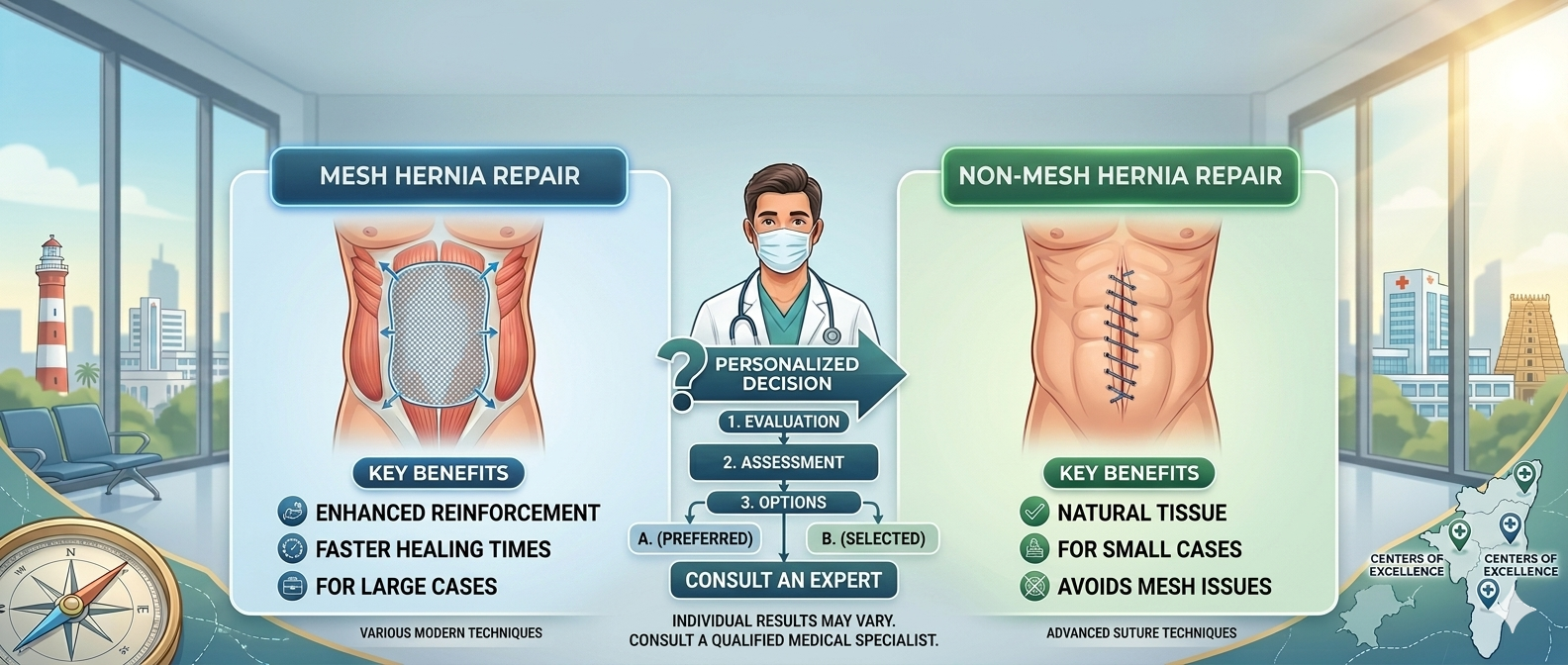
For most hernia repairs, mesh reinforcement lowers the risk of recurrence compared to tissue-only repair, especially in adult groin and ventral hernias. The mesh choice and placement technique matter, so surgeon experience is key.

Will the hernia come back?

Recurrence risk depends on hernia size, repair technique, patient factors (smoking, obesity, diabetes), and post-op strain. With proper repair and recovery discipline, most patients do very well.

Can I do daycare hernia repair if I live far away?

Often yes, if you can arrange safe travel and have a companion. Some patients choose to stay nearby for one night for comfort. Your surgeon will advise what is best for you.

How soon can I return to office?

Many patients with desk jobs return within 3 to 7 days, depending on pain and commute. Jobs involving lifting require longer restriction, often 4 to 6 weeks or as advised.

How Dr. Kumar Chooses the Right Hernia Repair Method for Each Patient

When someone searches for the best hernia surgeon in chennai, they are rarely looking for a generic explanation of hernia surgery. Most people are searching with a personal worry behind the screen.

>> Will surgery be painful?”
>> “Will I be off work for weeks?”
>> “Do I need mesh?”
>> “What if it comes back?”
>> “Which method is safe for my age and health?”

At Dr Kumar – Billroth Hospitals, the approach is simple: no one gets a “one method fits all” recommendation. Hernia repair is not just about closing a gap. It is about choosing the right technique for the right body, at the right time, with the right recovery plan.

This guide explains how Dr. Kumar makes that decision, in a clear and practical way, so you feel confident before you say yes to surgery.

If you have been looking for the “best hernia surgeons near me” or “hernia hospital near me” at odd hours, you are not alone. Hernias create discomfort, anxiety, and that constant fear of “what if it gets worse.” The good news is that modern hernia repair is safe, predictable, and often quick to recover from, especially when the method is matched properly to the patient.

First, a Quick Reality Check: Not All Hernias are the Same

“Hernia” is one word, but it covers several different problems. The repair method depends heavily on what kind of hernia you have and what your daily life looks like.

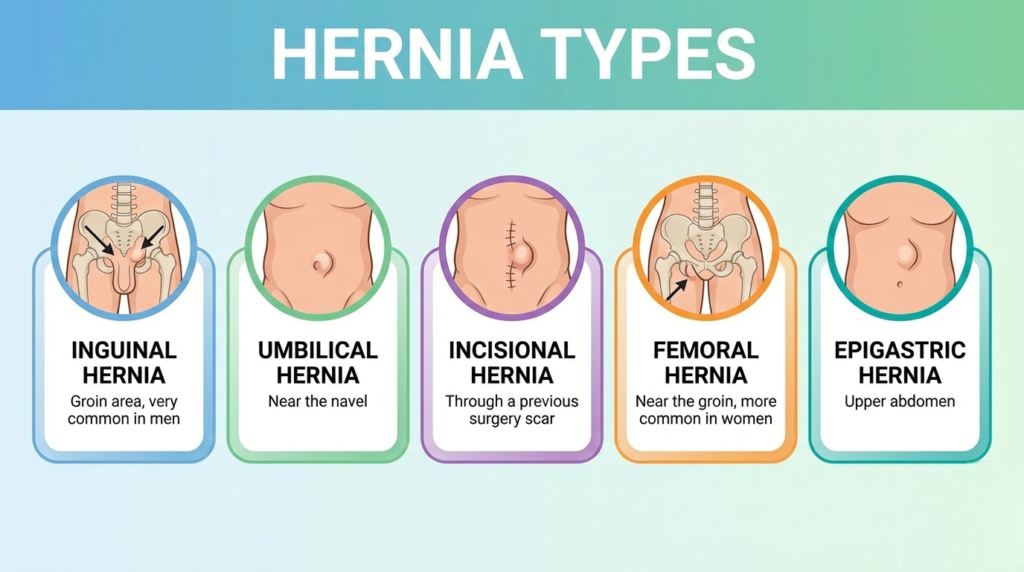
Common types include:

>> Inguinal hernia (groin area, very common in men)
>> Umbilical hernia (near the navel)
>> Incisional hernia (through a previous surgery scar)
>> Femoral hernia (near the groin, more common in women)
>> Epigastric hernia (upper abdomen)

Two people can have the same label but very different realities. One may have a small bulge with mild discomfort. Another may have pain, a large defect, or a hernia that returned after earlier surgery.

That is why Dr. Kumar’s evaluation starts with understanding the person, not just the hernia.

Step 1: Dr. Kumar lListens for the Clues Patients Don’t Realize they are Giving

A good hernia plan begins with the story.

During your visit, Dr. Kumar will ask questions that may feel simple, but they matter a lot:

>> When did you first notice the bulge?
>> Does it reduce when you lie down?
>> Is there pain while coughing, lifting, or standing long hours?
>> Any nausea, vomiting, or sudden severe pain?
>> Have you had surgery in the same area before?
>> What is your work routine: desk job, driving, lifting, sports?
>> What recovery timeline do you need realistically?

A skilled hernia specialist doctor can often predict the complexity of a repair just by combining symptoms with physical findings.

This is also where risks are identified early. For example, a hernia that suddenly becomes very painful and does not reduce needs urgent attention. Not everything can wait for “a convenient date.”

Step 2: Physical Examination Decides More Than People Think

Hernias can look dramatic in photos, but the real surgical decision comes from hands-on assessment.

Dr. Kumar checks:

>> Size of the defect
>> Strength of surrounding tissue
>> Whether the hernia is reducible
>> Whether it is likely to be complex or straightforward
>> Signs that the hernia is under strain

This step also clarifies whether you might need imaging (like an ultrasound or CT scan). Many patients do not need multiple tests, but imaging can help when the hernia is not clearly felt, when the swelling is intermittent, or when previous surgeries have altered anatomy.

Step 3: The “Best” Method Depends on Your Hernia Type and Your Life

People often ask: “Doctor, what is the best option?”

The honest answer is: the best hernia repair method is the one that suits your hernia and your body, and gives you the safest recovery with the lowest chance of recurrence.

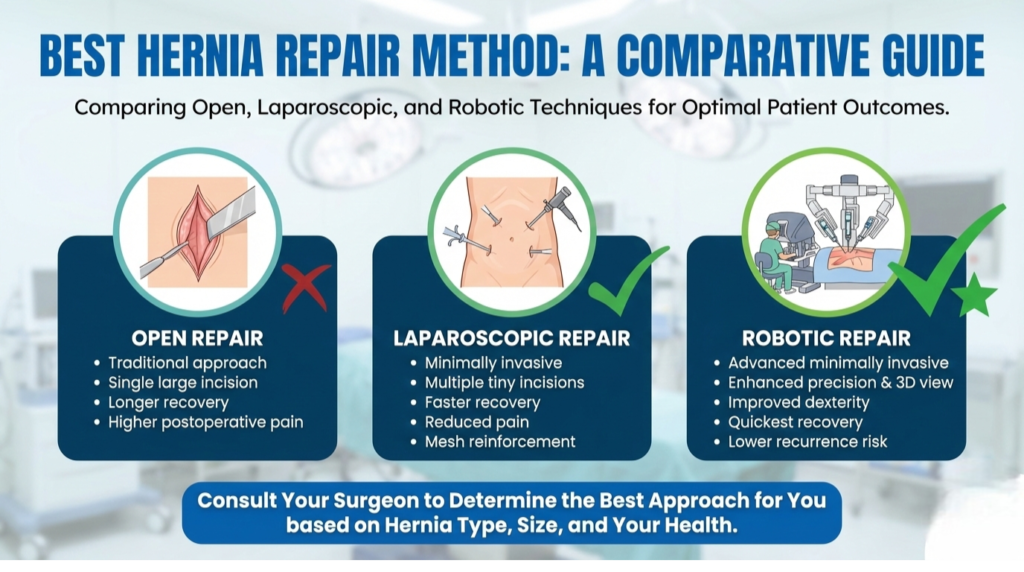
At Billroth Hospitals, Dr. Kumar generally considers these primary repair approaches:

1) Laparoscopic Hernia Repair (keyhole surgery)

Small incisions, camera-guided repair, usually less visible scarring.

Why it may be chosen

>> Faster return to routine for many patients
>> Less wound discomfort for many cases
>> Helpful for bilateral hernias (both sides)
>> Helpful for some recurrent hernias after open repair

What patients like

>> Often quicker mobility
>> Often lower wound-related issues

2) Robotic Hernia Repair

Robotic assistance can help with precision in complex hernias.

Why it may be chosen

>> Some complex or larger repairs
>> Cases where refined suturing and dissection can help
>> Certain abdominal wall reconstructions

What patients like

>> Precision-focused approach in selected cases

Dr. Kumar’s job is to recommend what fits, not what sounds advanced. Technology is helpful only when it improves outcomes for that specific patient.

3) Open Hernia Repair

This is done through a single incision over the hernia site.

Why it may be chosen

>> Very large hernias or complex anatomy
>> Some recurrent hernias
>> Certain patients who are not ideal candidates for laparoscopy
>> Situations where local or regional anesthesia may be preferred

What patients like

>> Reliable method with long track record
>> Often cost-effective
>> Can be a good fit for selected cases

Dr. Kumar’s job is to recommend what fits, not what sounds advanced. Technology is helpful only when it improves outcomes for that specific patient.

Step 4: Mesh or No Mesh? Dr. Kumar Explains it in Plain Language

The “mesh question” is one of the biggest reasons people delay surgery.

Here is the simplest way to think about it:

>> A hernia is a weakness in the wall.
>> Closing it with stitches alone may work for very small defects in selected cases.
>> For many adult hernias, mesh strengthens the repair and reduces recurrence risk.

Dr. Kumar discusses mesh decisions based on:

>> Size of the defect
>> Tissue quality
>> Hernia type and location
>> Past repairs and recurrences
>> Infection risk factors
>> Lifestyle and lifting needs

Instead of rushing the conversation, the goal is clarity. You should leave knowing why mesh is recommended or why it may be avoided in your case.

Step 5: The Patient’s Health Profile Shapes the Method

Two patients with the same hernia size may get different recommendations because of health factors such as:

>> Diabetes control
>> Heart or lung conditions
>> Weight and abdominal pressure
>> Smoking history
>> Medications that affect bleeding
>> Previous abdominal surgeries
>> Chronic cough or constipation (both increase strain)

A method that is “ideal on paper” can become “not ideal” if it increases anesthesia risk or wound risk for that person.

This is where a senior surgeon’s judgement matters. It is also why many patients choose Dr. Kumar when looking for the best hernia surgeon in chennai. The decision is not just technical. It is personal and safety-driven.

Step 6: What Recovery Do you Need, and What Can you Realistically Do?

A hernia repair plan should match real life, not wishful thinking.

Dr. Kumar considers:

>> Do you need to return to a desk job quickly?
>> Are you a driver who sits long hours?
>> Are you a caregiver at home?
>> Do you lift heavy objects at work?
>> Do you play sports or go to the gym regularly?

Based on this, the plan may include:

>> The approach (open vs laparoscopic vs robotic)
>> Pain control plan
>> Movement guidance for the first week
>> Return-to-work timeline that is realistic
>> Lifestyle adjustments to protect the repair

Many recurrences happen not because surgery “failed,” but because recovery guidance was unclear or ignored. A good plan prevents that.

Step 7: Dr. Kumar Uses a Decision Framework that Patients Can Understand

Patients often feel surgery decisions are mysterious. They should not be.

At Billroth Hospitals, you will see the logic clearly. You can explore it through this guide on how hernia surgery is decided, which breaks down the key decision points in an easy way.

Then, the method choice is discussed as a recommendation, not a sales pitch. If you want a surgeon who explains options without confusing medical language, this matters.

What “Personalized” Actually Means Here

A lot of websites say “personalized care.” At Dr Kumar – Billroth Hospitals, personalized hernia treatment means:

>> Your plan accounts for your hernia type and size
>> Your health risks are addressed before surgery
>> Your recovery needs are built into the method choice
>> Your work and lifestyle are factored in
>> You understand what is being done and why

That is a big difference from “We do laparoscopic surgery for everyone” or “Open surgery is always best.”

Patient Scenarios: How Different People Get Different Methods

To make this real, here are common scenarios (simplified) where method choices differ.

Scenario A: Working professional with bilateral groin hernia

A patient with hernias on both sides often benefits from laparoscopic repair because both sides can be addressed with the same small-incision approach. Return to routine can be faster for many.

Scenario B: Elderly patient with multiple medical conditions

Safety becomes the top priority. An open approach may be recommended if it reduces anesthesia complexity or suits the patient’s risk profile.

Scenario C: Hernia after previous abdominal surgery

Previous scars can change anatomy. Dr. Kumar chooses a method that avoids unnecessary risk, and sometimes recommends imaging first to map the area.

Scenario D: Recurrent hernia after previous repair

Recurrent hernias need extra thought. Often, changing the approach (open to laparoscopic, or vice versa) is considered so the repair is done through healthier tissue planes.

Why the Consultation Matters More Than the Technique

Many people search hernia hospital and choose based on distance. That is understandable. But hernia outcomes depend heavily on planning and surgeon experience.

A quality hernia surgery consultation is where you learn:

>> The exact type of hernia you have
>> Why a certain method is recommended
>> What recovery will look like in your case
>> What you should do before surgery to lower risk
>> The likely timeline to return to work and normal activity

If a consultation feels rushed, that is a red flag. Hernia repair is common, but it is still surgery. You deserve time and clarity.

What to Expect at Dr Kumar – Billroth Hospitals

Patients choose Billroth Hospitals because they want a balance of expertise, support, and safety.

You can expect:

>> Clear evaluation and explanation
>> A plan that fits your hernia and your lifestyle
>> Pre-surgery guidance (diet, activity, medication review)
>> Post-surgery support with practical recovery instructions
>> Follow-up that focuses on long-term success, not just discharge

If you have been searching for the best hernia surgeons near me, this is the difference you should look for: not marketing noise, but confident, consistent decision-making.

Simple Ways You Can Reduce Hernia Discomfort While Waiting For Treatment

If your hernia is reducible and not urgent, these steps may help reduce strain until surgery (or until you meet the doctor):

>> Avoid heavy lifting and sudden twisting
>> Treat constipation early (strain worsens hernia)
>> Manage chronic cough if present
>> Use support garments only if recommended
>> Do not ignore increasing pain or swelling

Important: If your hernia becomes suddenly painful, hard, or irreducible, or you feel nausea or vomiting, seek urgent care.

The Bottom Line: Method Choice is Not a Trend, it is a Decision

If you want the best hernia surgeon in chennai, look for someone who does not start by selling a technique. Look for someone who starts by understanding your hernia, your health, and your life.

That is how Dr. Kumar approaches hernia repair at Billroth Hospitals. The goal is not just surgery. The goal is a repair that stays strong, with recovery that fits your real world.

To understand your options and get a clear recommendation, explore best hernia repair method and book your consultation with Dr. Kumar at Billroth Hospitals.

If you are searching hernia specialist doctor, consider choosing based on judgement and planning, not just proximity. The right plan makes all the difference.

FAQs

Is laparoscopic always better than open surgery?

Not always. Laparoscopy is excellent for many cases, but open surgery can be the safer or smarter choice in others. The “better” method is the one that suits your case.

Will hernia surgery be very painful?

Most patients describe it as manageable, especially with good pain control and movement guidance. Many people are surprised that they can walk the same day.

How long will I need off work?

It depends on your job type and method. Desk jobs often return sooner than heavy lifting jobs. Dr. Kumar gives a realistic timeline, not an optimistic one.

What if my hernia comes back?

Recurrence risk drops when the method is chosen correctly, surgery is done well, and recovery instructions are followed. The plan is designed to prevent recurrence, not just repair today’s bulge.

Do I need surgery if it doesn’t hurt much?

Many hernias gradually worsen. Even if pain is mild today, the defect can enlarge. A consultation helps you decide timing safely.

Call Now Button