

When someone searches for the best hernia surgeon in chennai, they are rarely looking for a generic explanation of hernia surgery. Most people are searching with a personal worry behind the screen.
>> Will surgery be painful?”
>> “Will I be off work for weeks?”
>> “Do I need mesh?”
>> “What if it comes back?”
>> “Which method is safe for my age and health?”At Dr Kumar – Billroth Hospitals, the approach is simple: no one gets a “one method fits all” recommendation. Hernia repair is not just about closing a gap. It is about choosing the right technique for the right body, at the right time, with the right recovery plan.
This guide explains how Dr. Kumar makes that decision, in a clear and practical way, so you feel confident before you say yes to surgery.
If you have been looking for the “best hernia surgeons near me” or “hernia hospital near me” at odd hours, you are not alone. Hernias create discomfort, anxiety, and that constant fear of “what if it gets worse.” The good news is that modern hernia repair is safe, predictable, and often quick to recover from, especially when the method is matched properly to the patient.
First, a Quick Reality Check: Not All Hernias are the Same
“Hernia” is one word, but it covers several different problems. The repair method depends heavily on what kind of hernia you have and what your daily life looks like.
Common types include:
>> Inguinal hernia (groin area, very common in men)
>> Umbilical hernia (near the navel)
>> Incisional hernia (through a previous surgery scar)
>> Femoral hernia (near the groin, more common in women)
>> Epigastric hernia (upper abdomen)
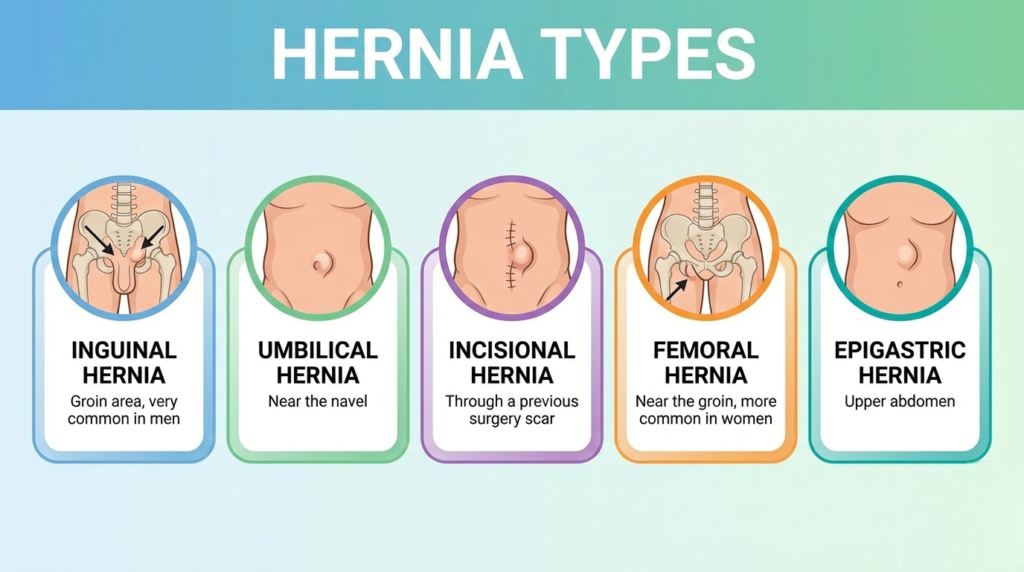
Two people can have the same label but very different realities. One may have a small bulge with mild discomfort. Another may have pain, a large defect, or a hernia that returned after earlier surgery.
That is why Dr. Kumar’s evaluation starts with understanding the person, not just the hernia.
Step 1: Dr. Kumar lListens for the Clues Patients Don’t Realize they are Giving
A good hernia plan begins with the story.
During your visit, Dr. Kumar will ask questions that may feel simple, but they matter a lot:
>> When did you first notice the bulge?
>> Does it reduce when you lie down?
>> Is there pain while coughing, lifting, or standing long hours?
>> Any nausea, vomiting, or sudden severe pain?
>> Have you had surgery in the same area before?
>> What is your work routine: desk job, driving, lifting, sports?
>> What recovery timeline do you need realistically?
A skilled hernia specialist doctor can often predict the complexity of a repair just by combining symptoms with physical findings.
This is also where risks are identified early. For example, a hernia that suddenly becomes very painful and does not reduce needs urgent attention. Not everything can wait for “a convenient date.”
Step 2: Physical Examination Decides More Than People Think
Hernias can look dramatic in photos, but the real surgical decision comes from hands-on assessment.
Dr. Kumar checks:
>> Size of the defect
>> Strength of surrounding tissue
>> Whether the hernia is reducible
>> Whether it is likely to be complex or straightforward
>> Signs that the hernia is under strain
This step also clarifies whether you might need imaging (like an ultrasound or CT scan). Many patients do not need multiple tests, but imaging can help when the hernia is not clearly felt, when the swelling is intermittent, or when previous surgeries have altered anatomy.
Step 3: The “Best” Method Depends on Your Hernia Type and Your Life
People often ask: “Doctor, what is the best option?”
The honest answer is: the best hernia repair method is the one that suits your hernia and your body, and gives you the safest recovery with the lowest chance of recurrence.
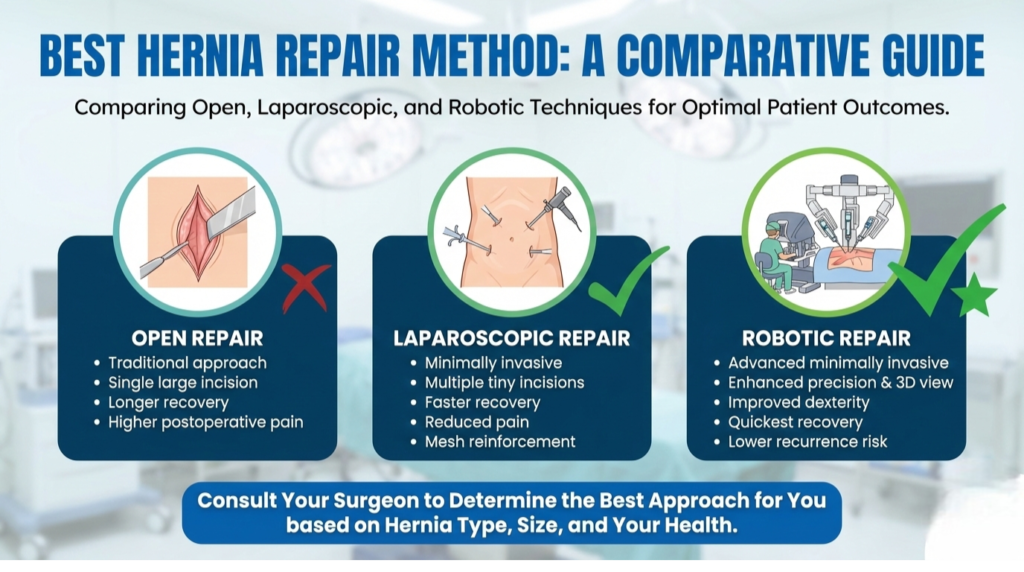
At Billroth Hospitals, Dr. Kumar generally considers these primary repair approaches:
1) Laparoscopic Hernia Repair (keyhole surgery)
Small incisions, camera-guided repair, usually less visible scarring.
Why it may be chosen
>> Faster return to routine for many patients
>> Less wound discomfort for many cases
>> Helpful for bilateral hernias (both sides)
>> Helpful for some recurrent hernias after open repair
What patients like
>> Often quicker mobility
>> Often lower wound-related issues
2) Robotic Hernia Repair
Robotic assistance can help with precision in complex hernias.
Why it may be chosen
>> Some complex or larger repairs
>> Cases where refined suturing and dissection can help
>> Certain abdominal wall reconstructions
What patients like
>> Precision-focused approach in selected cases
Dr. Kumar’s job is to recommend what fits, not what sounds advanced. Technology is helpful only when it improves outcomes for that specific patient.
3) Open Hernia Repair
This is done through a single incision over the hernia site.
Why it may be chosen
>> Very large hernias or complex anatomy
>> Some recurrent hernias
>> Certain patients who are not ideal candidates for laparoscopy
>> Situations where local or regional anesthesia may be preferred
What patients like
>> Reliable method with long track record
>> Often cost-effective
>> Can be a good fit for selected cases
Dr. Kumar’s job is to recommend what fits, not what sounds advanced. Technology is helpful only when it improves outcomes for that specific patient.
Step 4: Mesh or No Mesh? Dr. Kumar Explains it in Plain Language
The “mesh question” is one of the biggest reasons people delay surgery.
Here is the simplest way to think about it:
>> A hernia is a weakness in the wall.
>> Closing it with stitches alone may work for very small defects in selected cases.
>> For many adult hernias, mesh strengthens the repair and reduces recurrence risk.Dr. Kumar discusses mesh decisions based on:
>> Size of the defect
>> Tissue quality
>> Hernia type and location
>> Past repairs and recurrences
>> Infection risk factors
>> Lifestyle and lifting needs
Instead of rushing the conversation, the goal is clarity. You should leave knowing why mesh is recommended or why it may be avoided in your case.
Step 5: The Patient’s Health Profile Shapes the Method
Two patients with the same hernia size may get different recommendations because of health factors such as:
>> Diabetes control
>> Heart or lung conditions
>> Weight and abdominal pressure
>> Smoking history
>> Medications that affect bleeding
>> Previous abdominal surgeries
>> Chronic cough or constipation (both increase strain)
A method that is “ideal on paper” can become “not ideal” if it increases anesthesia risk or wound risk for that person.
This is where a senior surgeon’s judgement matters. It is also why many patients choose Dr. Kumar when looking for the best hernia surgeon in chennai. The decision is not just technical. It is personal and safety-driven.
Step 6: What Recovery Do you Need, and What Can you Realistically Do?
A hernia repair plan should match real life, not wishful thinking.
Dr. Kumar considers:
>> Do you need to return to a desk job quickly?
>> Are you a driver who sits long hours?
>> Are you a caregiver at home?
>> Do you lift heavy objects at work?
>> Do you play sports or go to the gym regularly?
Based on this, the plan may include:
>> The approach (open vs laparoscopic vs robotic)
>> Pain control plan
>> Movement guidance for the first week
>> Return-to-work timeline that is realistic
>> Lifestyle adjustments to protect the repair
Many recurrences happen not because surgery “failed,” but because recovery guidance was unclear or ignored. A good plan prevents that.
Step 7: Dr. Kumar Uses a Decision Framework that Patients Can Understand
Patients often feel surgery decisions are mysterious. They should not be.
At Billroth Hospitals, you will see the logic clearly. You can explore it through this guide on how hernia surgery is decided, which breaks down the key decision points in an easy way.
Then, the method choice is discussed as a recommendation, not a sales pitch. If you want a surgeon who explains options without confusing medical language, this matters.
What “Personalized” Actually Means Here
A lot of websites say “personalized care.” At Dr Kumar – Billroth Hospitals, personalized hernia treatment means:
>> Your plan accounts for your hernia type and size
>> Your health risks are addressed before surgery
>> Your recovery needs are built into the method choice
>> Your work and lifestyle are factored in
>> You understand what is being done and why
That is a big difference from “We do laparoscopic surgery for everyone” or “Open surgery is always best.”
Patient Scenarios: How Different People Get Different Methods
To make this real, here are common scenarios (simplified) where method choices differ.
Scenario A: Working professional with bilateral groin hernia
A patient with hernias on both sides often benefits from laparoscopic repair because both sides can be addressed with the same small-incision approach. Return to routine can be faster for many.
Scenario B: Elderly patient with multiple medical conditions
Safety becomes the top priority. An open approach may be recommended if it reduces anesthesia complexity or suits the patient’s risk profile.
Scenario C: Hernia after previous abdominal surgery
Previous scars can change anatomy. Dr. Kumar chooses a method that avoids unnecessary risk, and sometimes recommends imaging first to map the area.
Scenario D: Recurrent hernia after previous repair
Recurrent hernias need extra thought. Often, changing the approach (open to laparoscopic, or vice versa) is considered so the repair is done through healthier tissue planes.
Why the Consultation Matters More Than the Technique
Many people search hernia hospital and choose based on distance. That is understandable. But hernia outcomes depend heavily on planning and surgeon experience.
A quality hernia surgery consultation is where you learn:
>> The exact type of hernia you have
>> Why a certain method is recommended
>> What recovery will look like in your case
>> What you should do before surgery to lower risk
>> The likely timeline to return to work and normal activity
If a consultation feels rushed, that is a red flag. Hernia repair is common, but it is still surgery. You deserve time and clarity.
What to Expect at Dr Kumar – Billroth Hospitals
Patients choose Billroth Hospitals because they want a balance of expertise, support, and safety.
You can expect:
>> Clear evaluation and explanation
>> A plan that fits your hernia and your lifestyle
>> Pre-surgery guidance (diet, activity, medication review)
>> Post-surgery support with practical recovery instructions
>> Follow-up that focuses on long-term success, not just discharge
If you have been searching for the best hernia surgeons near me, this is the difference you should look for: not marketing noise, but confident, consistent decision-making.
Simple Ways You Can Reduce Hernia Discomfort While Waiting For Treatment
If your hernia is reducible and not urgent, these steps may help reduce strain until surgery (or until you meet the doctor):
>> Avoid heavy lifting and sudden twisting
>> Treat constipation early (strain worsens hernia)
>> Manage chronic cough if present
>> Use support garments only if recommended
>> Do not ignore increasing pain or swelling
Important: If your hernia becomes suddenly painful, hard, or irreducible, or you feel nausea or vomiting, seek urgent care.
The Bottom Line: Method Choice is Not a Trend, it is a Decision
If you want the best hernia surgeon in chennai, look for someone who does not start by selling a technique. Look for someone who starts by understanding your hernia, your health, and your life.
That is how Dr. Kumar approaches hernia repair at Billroth Hospitals. The goal is not just surgery. The goal is a repair that stays strong, with recovery that fits your real world.
To understand your options and get a clear recommendation, explore best hernia repair method and book your consultation with Dr. Kumar at Billroth Hospitals.
If you are searching hernia specialist doctor, consider choosing based on judgement and planning, not just proximity. The right plan makes all the difference.
FAQs
Is laparoscopic always better than open surgery?
Not always. Laparoscopy is excellent for many cases, but open surgery can be the safer or smarter choice in others. The “better” method is the one that suits your case.
Will hernia surgery be very painful?
Most patients describe it as manageable, especially with good pain control and movement guidance. Many people are surprised that they can walk the same day.
How long will I need off work?
It depends on your job type and method. Desk jobs often return sooner than heavy lifting jobs. Dr. Kumar gives a realistic timeline, not an optimistic one.
What if my hernia comes back?
Recurrence risk drops when the method is chosen correctly, surgery is done well, and recovery instructions are followed. The plan is designed to prevent recurrence, not just repair today’s bulge.
Do I need surgery if it doesn’t hurt much?
Many hernias gradually worsen. Even if pain is mild today, the defect can enlarge. A consultation helps you decide timing safely.