

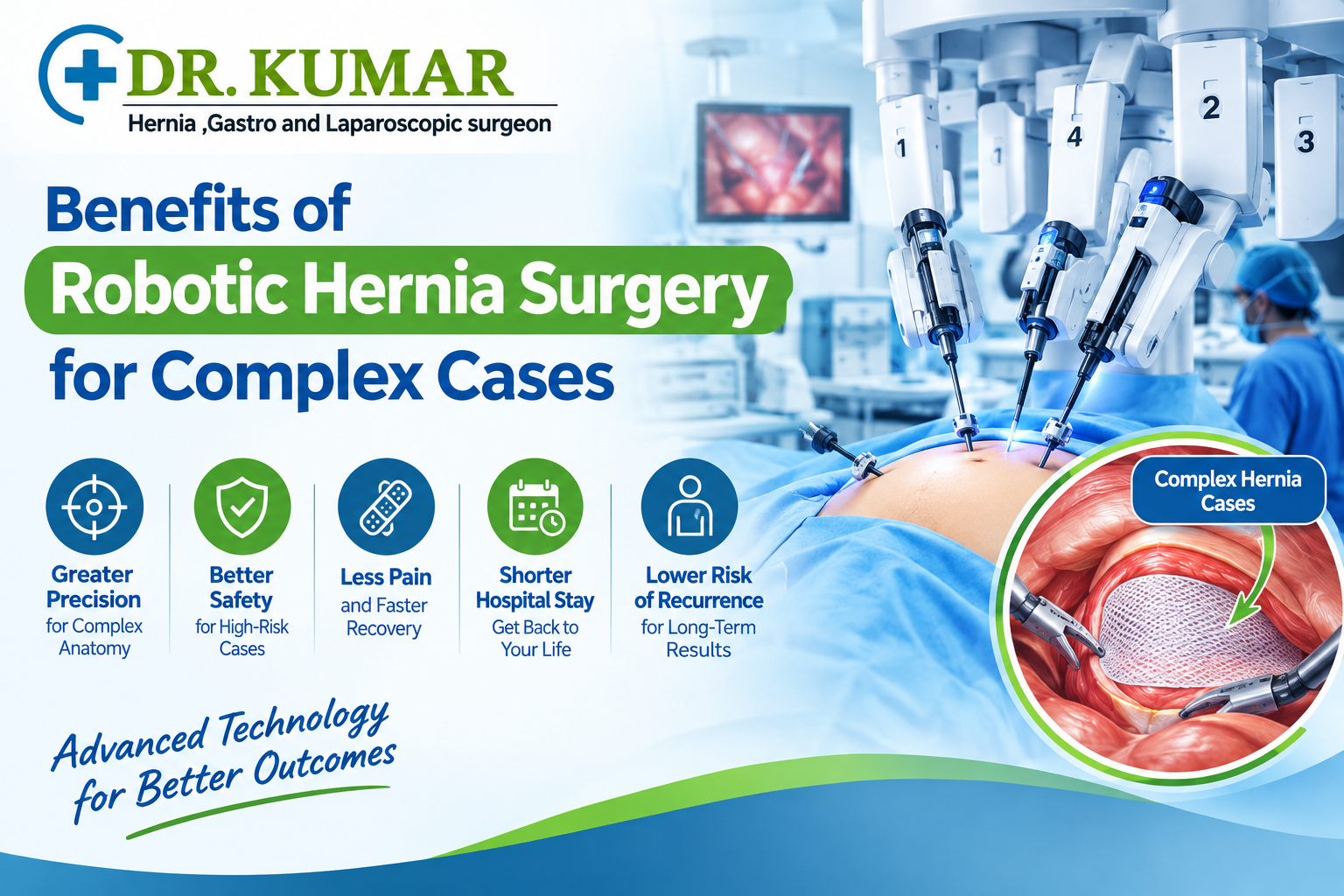
Complex hernias need more than a standard surgical approach.
A recurrent hernia, a large abdominal wall defect, previous mesh repair, multiple earlier abdominal surgeries or weakened abdominal muscles can make treatment more demanding. In such situations, choosing the right surgical technique becomes just as important as identifying the hernia itself.
Dr Kumar, a laparoscopic and robotic hernia surgeon in Chennai, treats complex hernias using three main surgical approaches:
- Laparoscopic surgery
- Robotic surgery
- Open surgery
Whenever possible and medically appropriate, greater emphasis is placed on minimally invasive laparoscopic and robotic techniques because they can offer better visualisation, smaller incisions and advanced access to difficult areas of the abdominal wall.
For patients exploring robotic surgery in Chennai, robotic hernia repair can be particularly useful in selected complex and recurrent cases where precision, suturing and abdominal wall reconstruction are important.
Why Do Complex Hernias Need Specialised Treatment?
A simple hernia and a complex hernia are not the same.
Some complex hernias develop after earlier surgery. Others may return following a previous repair. Large incisional hernias can also involve weakening or separation of the abdominal muscles.
Dr Kumar, hernia specialist in Chennai, evaluates several factors before deciding how the hernia should be repaired.
These may include:
- Size of the hernia defect
- Location of the hernia
- Previous hernia surgeries
- Existing mesh
- Scar tissue
- Strength of the abdominal wall
- Separation of abdominal muscles
- Number of previous abdominal operations
- Patient’s age and overall health
- CT scan findings
For this reason, complex hernia surgery is not simply about closing a defect. The aim is to restore abdominal wall strength and function while reducing the risk of future recurrence.
The Three Main Approaches to Hernia Surgery
Dr Kumar uses laparoscopic, robotic and open techniques depending on the needs of the patient.
1. Laparoscopic Hernia Surgery
Laparoscopic surgery is a minimally invasive technique performed through small incisions.
A camera and specialised surgical instruments are inserted into the abdomen, allowing Dr Kumar to examine the hernia and perform the repair without making a large incision.
For many patients, laparoscopic repair can provide advantages such as:
- Smaller incisions
- Reduced tissue disruption
- Better visualisation of the abdominal cavity
- Earlier mobilisation
- Potentially shorter recovery compared with large open incisions
- Ability to examine multiple hernia defects
As a laparoscopic hernia surgeon, Dr Kumar frequently considers this approach for suitable inguinal, ventral, incisional and recurrent hernias.
Techniques such as TEP, TAPP and eTEP may be selected depending on the type and location of the hernia.
2. Robotic Hernia Surgery
Robotic surgery is also a minimally invasive approach, but it provides additional flexibility and precision during certain complex repairs.
The robotic system is fully controlled by the surgeon. It does not perform the surgery independently.
Dr Kumar controls specialised robotic instruments from a surgical console while viewing the operating area in magnified three-dimensional detail.
This can be especially helpful in complex hernias that require:
- Precise suturing
- Extensive tissue dissection
- Abdominal wall reconstruction
- Repair around previous scar tissue
- Working in narrow or difficult anatomical spaces
- Reconstruction after recurrent hernia
Patients searching for robotic surgery in Chennai should understand that robotic technology is not automatically necessary for every hernia.
Dr Kumar hernia surgeon assesses whether the robotic approach provides a genuine advantage over standard laparoscopy.
3. Open Hernia Surgery
Open surgery remains an important option for certain patients.
In an open procedure, the surgeon reaches the hernia through a larger incision rather than using minimally invasive access.
Some very large, complicated or previously operated hernias may still require open reconstruction.
Dr Kumar uses the open approach when it offers the safest or most effective method for the individual patient.
However, where medically appropriate, laparoscopic and robotic approaches are often explored first because of their minimally invasive nature.
Why Robotic Surgery Can Be Valuable in Complex Hernias
Robotic surgery has expanded the possibilities of minimally invasive abdominal wall reconstruction.
For Dr Kumar hernia specialist, the value of robotic surgery lies in the additional control and flexibility it can offer during technically difficult operations.
1. Enhanced Three-Dimensional Visualisation
Complex hernia surgery often involves areas where normal anatomy has been altered.
Previous operations may leave scar tissue, adhesions or mesh around the abdominal wall.
Robotic systems provide magnified three-dimensional vision, helping the surgeon identify tissue planes and anatomical structures more clearly.
This enhanced visualisation can be particularly useful during recurrent hernia surgery.
2. Greater Instrument Flexibility
Traditional laparoscopic instruments are highly effective, but robotic instruments have articulated joints that can move more freely within the abdominal cavity.
This wrist-like movement can help Dr Kumar perform detailed suturing and dissection in confined spaces.
For abdominal wall reconstruction, this may offer a significant technical advantage in selected patients.
3. Useful for Recurrent Hernia Repair
A recurrent hernia needs careful evaluation.
The surgeon must understand why the previous repair failed and what has changed in the abdominal wall.
Dr Kumar recurrent hernia specialist may review:
- Previous operative notes
- Earlier mesh placement
- CT scan findings
- Scar tissue
- Defect size
- Abdominal muscle separation
In selected recurrent cases, robotic surgery may allow precise dissection and reconstruction while maintaining minimally invasive access.
4. Supports Advanced Abdominal Wall Reconstruction
Large or complex hernias sometimes require abdominal wall reconstruction.
In these cases, simply covering the defect may not be enough.
The surgeon may need to restore the position of the abdominal muscles and strengthen different layers of the abdominal wall.
Dr Kumar abdominal wall reconstruction surgeon may use advanced techniques such as:
- eTEP
- TAR
- Component separation
- Retromuscular mesh placement
- Advanced laparoscopic reconstruction
- Robotic abdominal wall reconstruction
In suitable patients, robotic assistance may allow some of these technically demanding procedures to be performed through smaller incisions.
5. Precise Suturing
Suturing is a major part of many complex hernia repairs.
Robotic instruments allow the surgeon to manipulate needles and tissue with a high degree of movement.
This can be helpful when closing large defects, reconstructing abdominal wall layers or positioning reinforcement material.
For Dr Kumar robotic hernia surgeon, this level of control can be particularly valuable during technically demanding cases.
6. Smaller Incisions for Selected Complex Repairs
One of the biggest advantages of both laparoscopic and robotic surgery is the ability to perform major procedures without necessarily creating a large abdominal incision.
Smaller incisions may result in less disruption of the abdominal wall.
However, patients should remember that the complexity of the operation still determines recovery.
A robotic abdominal wall reconstruction may involve small skin incisions but can still be a significant surgical procedure.
Laparoscopic vs Robotic vs Open Hernia Surgery
Patients often ask Dr Kumar which technique is best.
There is no single answer.
Laparoscopic Surgery
Often suitable for many routine and moderately complex hernias.
Potential benefits include:
- Small incisions
- Good internal visualisation
- Established minimally invasive techniques
- Faster mobilisation in suitable patients
Robotic Surgery
May be preferred when additional instrument flexibility and advanced suturing are helpful.
It can be useful for:
- Complex ventral hernias
- Recurrent hernias
- Abdominal wall reconstruction
- Difficult retromuscular dissection
- Advanced suturing requirements
Open Surgery
May be required for:
- Very large hernias
- Significant loss of abdominal wall structure
- Complex previous repairs
- Certain infected or complicated situations
- Cases where minimally invasive access is unsuitable
Dr Kumar hernia specialist chooses between these approaches according to the patient’s anatomy rather than using the same technique for every person.
Is Robotic Hernia Surgery Suitable for Everyone?
No.
Robotic surgery should only be used when there is a clear clinical reason.
Dr Kumar evaluates several factors before recommending robotic surgery in Chennai, including:
- Type of hernia
- Size of the defect
- Number of previous repairs
- Existing mesh
- Amount of scar tissue
- Abdominal muscle condition
- Patient fitness
- CT scan findings
- Anaesthesia suitability
In some patients, laparoscopic surgery may be sufficient.
In others, robotic surgery may offer additional advantages.
A smaller group may still benefit most from open surgery.
The treatment plan should always be personalised.
What Is the Role of eTEP in Complex Hernia Surgery?
The eTEP technique is an advanced minimally invasive method that allows the surgeon to work within specific layers of the abdominal wall.
Dr Kumar uses eTEP in selected patients where the hernia anatomy and abdominal wall condition make this approach appropriate.
The technique can be particularly useful when mesh needs to be positioned behind the abdominal muscles rather than inside the abdominal cavity.
Depending on the case, eTEP may be performed laparoscopically or with robotic assistance.
This reflects Dr Kumar’s broader approach of choosing the technique according to the patient rather than promoting one method for every hernia.
What About Robotic Gallbladder Surgery?
Robotic technology can also be used in selected gallbladder procedures.
Robotic gallbladder surgery uses the same basic principle of surgeon-controlled robotic instruments and enhanced three-dimensional visualisation.
Dr Kumar performs laparoscopic and robotic procedures for selected gallbladder conditions in addition to hernia surgery.
Again, the choice between laparoscopic and robotic surgery depends on the individual case.
Choosing a Hernia Surgeon in Chennai
Patients often search for terms such as the best robotic surgery hospital in Iindia, robotic hernia specialist, or advanced hernia surgeon in Chennai.
The more important question is who will actually perform the surgery and how much experience that surgeon has with different hernia techniques.
Dr Kumar hernia surgeon focuses on laparoscopic, robotic and complex abdominal wall surgery.
This matters because a surgeon experienced in all three approaches can choose the method based on the patient rather than being limited to one technique.
When selecting a surgeon, patients should consider experience with:
- Laparoscopic hernia repair
- Robotic hernia repair
- eTEP
- TEP
- TAPP
- Recurrent hernia surgery
- TAR
- Component separation
- Abdominal wall reconstruction
- Open hernia repair when necessary
Dr Kumar at Billroth Hospitals
The purpose of treatment is not to promote a hospital or a piece of technology.
The focus is on the surgeon, the decision-making process and the treatment plan.
Dr Kumar at Billroth Hospitals provides laparoscopic, robotic and open surgical options for patients with simple, recurrent and complex hernias.
As a laparoscopic and robotic surgeon, Dr Kumar places greater emphasis on minimally invasive approaches whenever they are suitable and safe for the patient.
Open surgery remains available for cases where it offers a better surgical solution.
Experience Matters More Than Technology
A robotic system can provide excellent visualisation and instrument control.
But the robot does not decide:
- Where the mesh should be placed
- Which tissue plane should be used
- Whether muscles need reconstruction
- How the previous repair failed
- Whether robotic surgery is necessary
- Whether laparoscopy would be sufficient
- Whether an open procedure is safer
Those decisions come from the surgeon.
For this reason, patients considering robotic surgery in Chennai should focus on the experience of the surgeon rather than simply choosing a hospital because it has robotic equipment.
Dr Kumar’s approach combines experience in laparoscopic surgery, robotic surgery and open abdominal wall reconstruction so that treatment can be adapted to the individual patient.
When Should You Consult Dr Kumar for a Complex Hernia?
You may consider consulting Dr Kumar hernia specialist if you have:
- A hernia that has returned after surgery
- A large incisional hernia
- Pain or swelling after previous hernia repair
- Previous mesh surgery
- Multiple abdominal surgeries
- Separation of abdominal muscles
- A complex abdominal wall defect
- Been advised to undergo abdominal wall reconstruction
Bringing previous operation records, CT scans and details about earlier mesh placement can help with surgical planning.
The consultation can then determine whether laparoscopic, robotic or open surgery offers the most suitable option.
Final Thoughts
Complex hernia surgery requires more than choosing between a small incision and a large incision.
The surgeon must understand the abdominal wall, previous surgery, scar tissue, muscle function and long-term repair strategy.
Dr Kumar uses three principal approaches:
- Laparoscopic surgery
- Robotic surgery
- Open surgery
For suitable patients, laparoscopic and robotic techniques are prioritised because they allow complex surgery to be performed through minimally invasive access.
Robotic surgery can be particularly useful when advanced suturing, difficult dissection or abdominal wall reconstruction is required.
Open surgery remains an important option for patients whose condition cannot be effectively managed through minimally invasive techniques.
For anyone considering robotic surgery in Chennai, the key is not simply access to robotic technology. It is choosing an experienced laparoscopic and robotic hernia surgeon who can decide when the technology actually adds value.
That is the approach followed by Dr Kumar at Billroth Hospitals.
Frequently Asked Questions
1. Which types of hernia surgery does Dr Kumar perform?
Dr Kumar performs laparoscopic, robotic and open hernia surgery. Whenever suitable, greater emphasis is placed on laparoscopic and robotic approaches because they provide minimally invasive options for many routine and complex hernias.
2. Is robotic surgery better than laparoscopic hernia surgery?
Not necessarily. Laparoscopic surgery works very well for many patients. Robotic surgery may offer additional flexibility, three-dimensional visualisation and easier suturing in selected complex cases. Dr Kumar chooses the approach according to the patient’s hernia and abdominal wall anatomy.
3. Can Dr Kumar perform robotic surgery for recurrent hernias?
Yes, selected recurrent hernias may be suitable for robotic repair. Dr Kumar evaluates previous surgery, existing mesh, scar tissue, CT scan findings and abdominal wall condition before recommending laparoscopic, robotic or open surgery.
4. When is open hernia surgery required?
Open surgery may be recommended for very large, complicated or previously operated hernias where minimally invasive surgery is not considered the safest or most effective option. Dr Kumar evaluates all three approaches before deciding.
5. How do I know whether laparoscopic or robotic hernia surgery is right for me?
The decision depends on the type, size and location of the hernia, previous surgeries, mesh placement, abdominal wall condition and your overall health. A consultation with Dr Kumar hernia specialist can help determine whether laparoscopic, robotic or open surgery is most appropriate.