

A small swelling near the groin may not seem particularly worrying. It might appear when you lift something heavy, cough or stand for several hours, then disappear when you lie down. Many people carry on with their routine, assuming the problem will settle by itself.
But not every groin swelling is a straightforward hernia.
Sometimes, two different types of hernia develop together on the same side of the groin. Doctors call this a pantaloon hernia, a condition that needs careful assessment because both defects must be identified when planning surgical repair.
If you have been diagnosed with a pantaloons hernia, or your doctor suspects a complex inguinal hernia, understanding the condition can help you make an informed treatment decision.
At Dr Kumar at Billroth Hospitals, patients in Chennai can seek specialist assessment for groin hernias, including laparoscopic and robotic surgical treatment where appropriate.
What Is a Pantaloon Hernia?
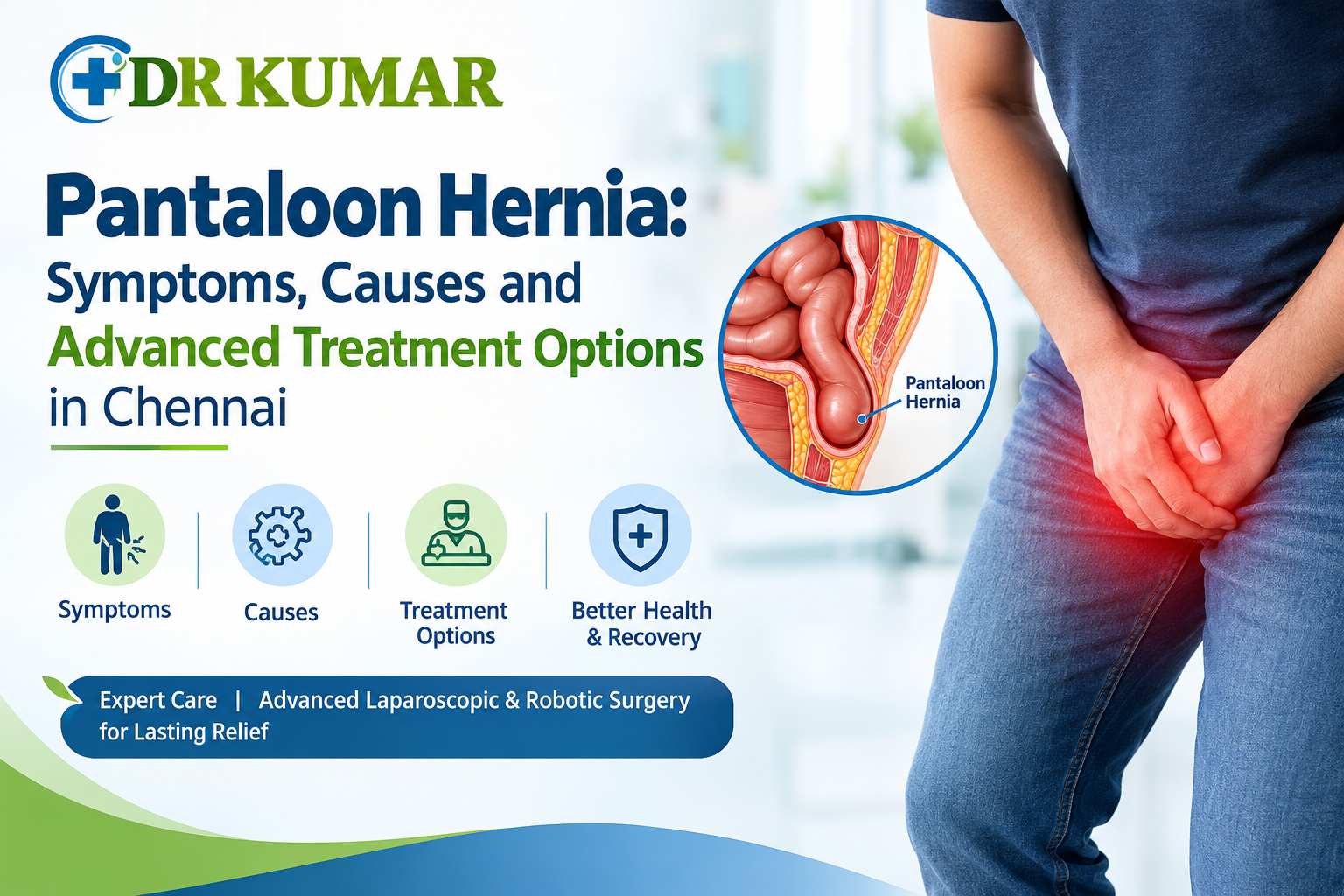
A pantaloon hernia is a type of inguinal hernia in which a direct hernia and an indirect hernia develop together on the same side of the groin.
To understand why this matters, consider how the two hernias differ.
A direct inguinal hernia develops when abdominal tissue pushes through a weakened area in the lower abdominal wall. An indirect inguinal hernia follows a passage through the inguinal canal, often involving an underlying weakness that has existed for many years.
In a pantaloon hernia, both defects are present simultaneously. They lie on opposite sides of the inferior epigastric blood vessels, creating an appearance that resembles a pair of trousers. This explains the unusual name.
The condition is also called a saddlebag hernia.
Although some people search online for pantaloons hernia, the standard medical term is pantaloon hernia.
What makes the condition important is not simply the presence of two hernia sacs. A surgeon needs to recognise both defects and plan a repair that addresses the affected area adequately.
Missing one component could leave the patient with a persistent or recurrent groin hernia.
Pantaloon Hernia Symptoms: What Should You Watch For?
One of the confusing aspects of a pantaloon hernia is that its symptoms often resemble those of an ordinary inguinal hernia.
You may not realise there are two defects because they do not necessarily produce two separate, visible swellings.
1. A Noticeable Lump in the Groin
The most common sign is a swelling on one side of the groin. It may become more prominent when standing, coughing or straining.
Some people notice it while bathing or changing clothes. Others become aware of it only after exercise or physical work.
2. A Dragging or Heavy Sensation
A persistent feeling of pressure in the lower abdomen or groin is another possible symptom.
You might notice discomfort after a long commute, an extended period of standing or a physically demanding working day.
3. Pain During Physical Activity
Lifting heavy objects, bending repeatedly or exercising can increase pressure inside the abdomen and make an existing hernia more noticeable.
The discomfort may be mild initially, but worsening pain deserves medical attention.
4. Swelling That Reduces When Lying Down
Some hernias become less visible when a person lies flat because their contents move back towards the abdomen.
However, a swelling that disappears temporarily has not necessarily healed.
5. Discomfort Extending Towards the Scrotum
In men, an inguinal hernia may extend towards the scrotum, causing swelling or discomfort.
Not every patient experiences all these symptoms. Some hernias produce little pain, while others interfere considerably with everyday activities.
If you repeatedly notice a groin lump, arrange a surgical consultation rather than relying on symptoms alone to identify the condition.
What Causes a Pantaloon Hernia?
There is no single explanation for why someone develops a pantaloon hernia.
The condition involves weaknesses in two neighbouring areas of the groin. Several factors may contribute to the development or progression of these weaknesses.
Age-related tissue changes: As people grow older, the structures supporting the abdominal wall can become weaker.
Inherited susceptibility: Some individuals have connective tissue characteristics or anatomical weaknesses that make hernias more likely.
Repeated abdominal pressure: Chronic coughing, constipation and frequent straining can contribute to pressure on vulnerable areas.
Heavy physical activity: Repeated lifting may aggravate an existing weakness, although lifting alone does not explain every hernia.
Previous hernia history: Patients who have undergone earlier groin hernia surgery may require a more detailed assessment if swelling appears again.
A pantaloon hernia can occur in someone who is otherwise healthy and physically active.
Rather than blaming one activity, the priority should be to understand the anatomy and determine whether treatment is needed.
How Is a Pantaloon Hernia Diagnosed?
Diagnosing a groin hernia begins with a discussion about your symptoms, followed by a physical examination.
A hernia surgeon in Chennai may ask when the swelling first appeared, whether it changes with movement and if you have undergone previous abdominal surgery.
During the examination, you may be asked to stand or cough so the surgeon can assess the swelling.
However, identifying a pantaloon hernia can be more complicated than recognising a single inguinal hernia.
Depending on the findings, investigations may include:
- Ultrasound: Useful when the swelling is difficult to assess or the diagnosis is uncertain.
- CT scan: May help clarify more complicated anatomy or suspected recurrent hernias.
- Surgical assessment: In some patients, the direct and indirect components are confirmed during the operation.
Not everyone needs advanced imaging.
An experienced specialist considers the examination findings, symptoms and medical history before recommending additional tests.
Is a Pantaloon Hernia Dangerous if Left Untreated?
A pantaloon hernia does not automatically mean you need emergency surgery.
However, an untreated inguinal hernia can occasionally develop serious complications.
One complication is incarceration, where tissue becomes trapped and cannot return to its normal position. A more dangerous complication is strangulation, where the blood supply to the trapped tissue becomes restricted.
Seek emergency medical attention if you experience:
- Sudden, severe groin or abdominal pain
- A swelling that becomes hard, tender or cannot be pushed back as before
- Persistent vomiting or significant abdominal bloating
- Fever or skin colour changes around a painful swelling
- Difficulty passing stool or gas alongside worsening abdominal symptoms
These symptoms should never be managed by waiting for a routine appointment.
For patients with mild symptoms, the decision about surgery depends on examination findings, overall health and individual risk. A surgeon can explain whether observation is appropriate or planned repair would be preferable.
Advanced Pantaloon Hernia Treatment Options in Chennai
A hernia does not usually close permanently through medication, exercise or wearing a support belt.
Surgery is the definitive way to repair the underlying defect when treatment is required.
For pantaloon hernias, the surgical plan must account for both the direct and indirect components.
Modern minimally invasive techniques offer treatment options for suitable patients.
1. Laparoscopic Pantaloon Hernia Surgery
Laparoscopic surgery is a widely established method for repairing inguinal hernias.
The surgeon works through small incisions using a camera and specialised surgical instruments.
Common approaches include:
TAPP (Transabdominal Preperitoneal Repair): The surgeon accesses the abdominal cavity and places reinforcing mesh in the preperitoneal space to cover the affected groin area.
TEP (Totally Extraperitoneal Repair): The surgeon repairs the hernia within the preperitoneal space without entering the main abdominal cavity.
For a pantaloon hernia, the surgeon identifies both components and ensures the repair covers the relevant defects.
In appropriate patients, laparoscopic surgery may provide advantages such as smaller incisions, less postoperative discomfort and an earlier return to certain routine activities.
The actual recovery depends on the individual and the complexity of the procedure.
2. Robotic Pantaloon Hernia Surgery
Robotic-assisted hernia surgery is another minimally invasive option.
During the procedure, the surgeon controls robotic instruments from a console. The technology provides magnified three-dimensional visualisation and instruments designed for precise movements.
Robotic assistance may be considered for selected complex or recurrent hernias, depending on the anatomy and the surgeon’s assessment.
However, robotic surgery is not automatically better than conventional laparoscopy for every pantaloon hernia.
Both approaches can be effective when used appropriately.
3. Mesh-Based Hernia Repair
For most adults undergoing inguinal hernia repair, surgical mesh is recommended to reinforce the weakened area and reduce the chance of recurrence.
In pantaloon hernia surgery, suitable mesh placement can help cover both defects.
The surgeon should explain the proposed mesh technique, possible complications, and the risks of recurrence or persistent discomfort.
Non-mesh repair may be considered in selected circumstances, but this requires individual evaluation.
What Is Recovery Like After Pantaloon Hernia Surgery?
Recovery is an important concern, particularly for patients who work long hours, travel frequently or have physically demanding jobs.
After minimally invasive hernia repair, many patients can begin gentle walking relatively early.
Some return to desk-based activities within several days, while others need longer. Heavy lifting and strenuous exercise generally require a more gradual return, guided by the surgeon.
You may experience temporary groin discomfort, swelling or bruising during the initial healing period.
Before leaving the hospital, make sure you understand:
- How to care for the surgical wounds
- Which medicines to take
- When to resume driving and working
- What activities to avoid temporarily
- Which symptoms require medical review
Recovery is not a competition. Following personalised postoperative advice is more useful than comparing your progress with someone else’s.
Choosing the Right Hernia Surgeon and Hospital in Chennai
When dealing with a pantaloon hernia, surgical experience matters because the condition involves two defects in the same groin.
If you are searching for a hernia surgeon in Chennai, consider whether the specialist regularly manages inguinal, recurrent and anatomically complex hernias.
It is equally important to choose a hospital with appropriate surgical, anaesthesia and postoperative facilities.
Patients looking for the best hospital for hernia treatment in Chennai should consider the surgeon’s relevant experience, the available treatment options, communication during consultations and the quality of follow-up care.
At Dr Kumar at Billroth Hospitals, patients have access to specialist hernia assessment and surgical planning.
Dr Kumar has more than 29 years of surgical experience and reports performing over 10,000 hernia operations, including laparoscopic procedures and complex hernia repairs.
His areas of practice include laparoscopic and robotic hernia surgery, recurrent hernia management and abdominal wall reconstruction.
The approach begins with understanding the patient’s condition before recommending a particular operation.
For patients diagnosed with a pantaloon hernia, this individualised assessment is particularly valuable.
How Much Does Pantaloon Hernia Surgery Cost in Chennai?
The cost of surgery depends on several practical factors.
These include the chosen surgical technique, mesh requirements, hospital stay, preoperative investigations, anaesthesia and whether the hernia has additional complications.
Laparoscopic and robotic procedures may have different costs because of equipment and operating requirements.
Before proceeding, ask for an estimate that explains what is included and whether insurance or cashless hospitalisation may be available under your policy.
The least expensive option is not necessarily the most appropriate option. The objective is a well-planned repair suited to your medical needs.
Consult Dr Kumar at Billroth Hospitals for Pantaloon Hernia Treatment
Living with an unexplained groin swelling can be uncomfortable, especially when you are unsure whether it needs surgery.
A consultation can help establish the diagnosis, assess the risk of complications and explain the treatment options available to you.
Dr Kumar at Billroth Hospitals, Chennai, provides specialist consultations for inguinal and complex hernias, including assessment for laparoscopic and robotic repair.
Whether you have recently noticed a swelling, received an ultrasound report or are considering treatment after a previous hernia operation, specialist advice can help you make a more confident decision.
Book a consultation with Dr Kumar at Billroth Hospitals in Chennai to discuss your symptoms and the most suitable next steps.
Frequently Asked Questions About Pantaloon Hernia
1. What is the difference between a pantaloon hernia and a normal inguinal hernia?
A typical inguinal hernia involves either a direct or an indirect defect. A pantaloon hernia involves both types on the same side of the groin. Because there are two defects, surgical planning must account for both components.
2. Can a pantaloon hernia be treated without surgery?
A pantaloon hernia does not normally heal on its own. Some patients with minimally symptomatic inguinal hernias may be suitable for careful observation, depending on their circumstances. When repair is required, surgery is the definitive treatment. A specialist can assess whether monitoring is appropriate for your condition.
3. Is laparoscopic surgery suitable for pantaloon hernia treatment?
Yes, laparoscopic surgery is an established option for many patients with pantaloon hernias. Techniques such as TAPP and TEP can allow the surgeon to assess the groin anatomy and repair both defects. Suitability depends on the patient’s medical condition, previous operations and surgical findings.
4. How long does recovery take after pantaloon hernia surgery?
Recovery varies according to the surgical technique, overall health and work requirements. Many patients resume light daily activities within a few days after minimally invasive repair, but strenuous activity may need to be postponed. Your surgeon will provide a recovery plan based on the actual procedure.
5. How do I choose the best hospital for hernia treatment in Chennai?
Look for a hospital that offers experienced hernia surgeons, suitable laparoscopic and robotic facilities, reliable anaesthesia services and postoperative support. Dr Kumar at Billroth Hospitals provides consultations for routine, recurrent and complex hernias, with treatment recommendations based on individual clinical needs.