
Herniais one of the most common surgical conditions seen inboth men and womenacross different age groups. Usually, it presents as abulge in the area that may increase with standing, coughing, or straining.
While early cases may appear mild, Hernia is a structural problemthat doesnot heal on its own. Over time, it can increase in size and lead to complications.
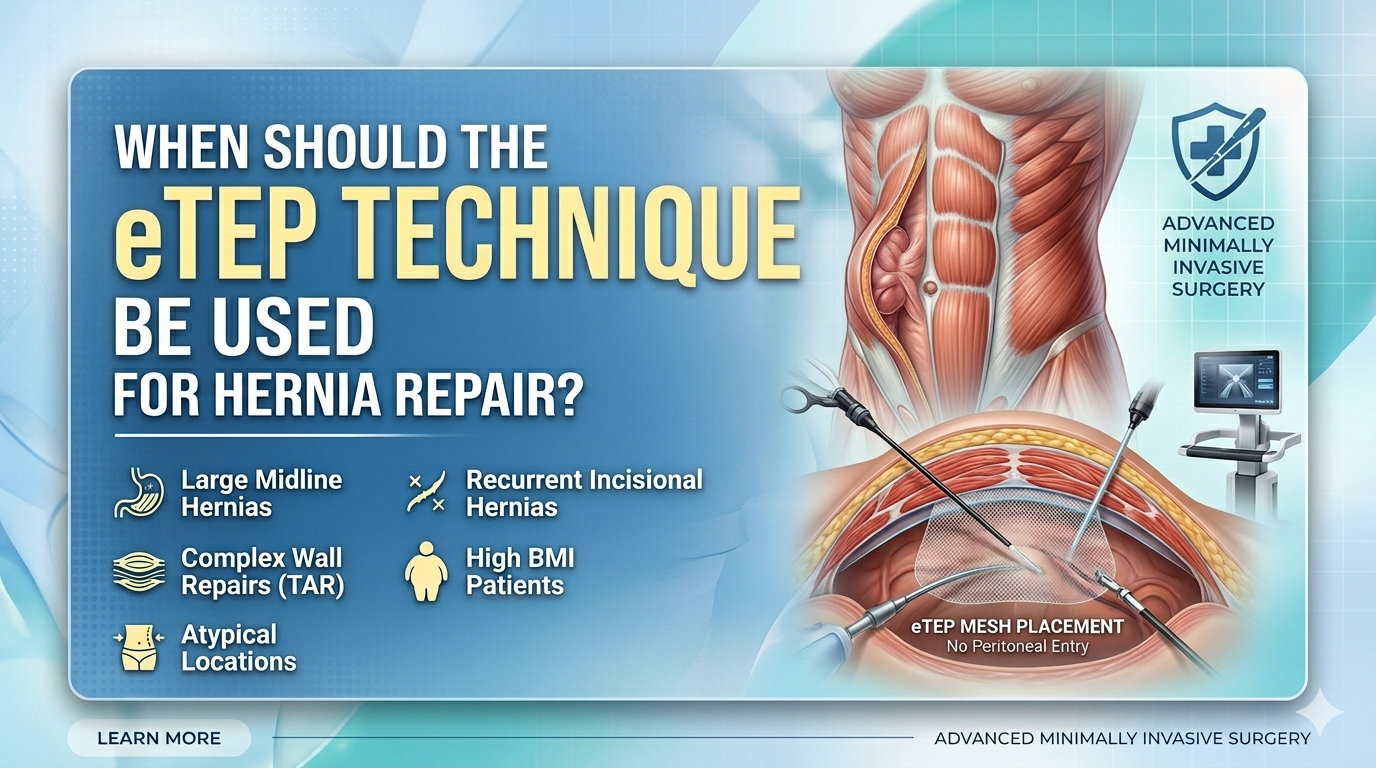
Modern hernia care has moved towards advanced and minimally invasive techniques. Among these advanced methods is eTEP Hernia Repair, which has gained importance as a reliable and effective approach. Many patients want to know when this technique is advised and whether it is suitable for their condition.
This article explains about the pros and cons of eTEP technique, and when hernia surgeons like Dr. Kumar use the eTEP technique in hernia surgery, how it compares with other approaches, and what factors are considered before choosing this method.
DR KUMAR one of the Top Hernia Surgeon in Chennai and an expert in eTEP technique uses this technique inComplex Hernia due to Enhanced vision,safety, Precision and Faster Recovery for the Patients and he explains in this article about this method and Benefits it offers over the Technique.
WHAT IS eTEP/ UNDERSTANDING THE ETEP HERNIA REPAIR
The term eTEP Hernia Repair stands for Enhanced Totally Extraperitoneal repair. It is an advanced Laparoscopic method used for Inguinal hernia, Umbilical and Ventral hernia surgery. It is a modified and improved version of the earlier technique TEP- Total Extra peritoneal Repair, In this extraperitoneal approach, surgery is done outside the abdominal cavity,( Peritoneal cavity) and hence the intestines and internal organs are not disturbed, leading to early return of intestinal functions.
- Better visualisation
- eTEP provides a bigger, larger field and a better view of the anatomy, making it easier for hernia repair.
- The hernia defect isrepaired with a larger mesh.
- A mesh is placed into the preperitoneal space to strengthen the abdominal wall.
- This eTEP technique is an improvement over earlier Laparoscopic TEP methods and provides better working space and visibility for the surgeon, enabling the surgeon to deploy a bigger mesh, leading to less recurrence.
HISTORY OF eTEP FOR HERNIA
Initially, open surgery was the method used for hernia repair. With the onset of the Laparoscopic era, minimal access surgery Laparoscopic Hernia Surgery was started. In the Laparoscopic method, the preperitoneal plane was dissected and a mesh was placed in the preperitoneal plane. This Laparoscopic Method initially had two approaches:
TAPP: Transabdominal Preperitoneal, where the peritoneal cavity is entered and then a preperitoneal plane is created to place the mesh.
Extraperitoneal approach: In this, the peritoneal cavity is not entered and the peritoneum is intact and Surgery is done outside the Peritoneal Cavity .
Initially, this technique was called TEP: Total Extra-Peritoneal Repair is done only for inguinal hernia, especially bilateral, and the initial port was placed just below the umbilicus for the camera. Hence the field which could be dissected was very small.
Below the Umbilicus.Since the space was very narrow [in TEP], there was no clear vision and only a smaller size of mesh could be kept, leading to more recurrence.
To increase the vision and to increase the field, Dr. Jorge Daes invented the technique called eTEP Enhanced or Extended TEP where the initial port is inserted well above the umbilicus, leading to a bigger area to be dissected, leading to better vision,and bigger mesh placement.
THE EVOLUTION OF eTEP
Hernia Surgery→ Open Hernia Surgery→
→Laparoscopic Hernia Surgery→1) TAPP
→2)TEP→eTEP
eTEP – Initially used for ventral hernia, eTEP quickly gained popularity for inguinal hernia surgery as well.
WHY DR KUMAR PREFERS THE eTEP TECHNIQUE
Dr. Kumar, one of the Top Hernia Surgeons in Chennai, India, prefers the eTEP technique for hernia surgery due to the following reasons:
Minimally Invasive Procedure: eTEP requires only small incisions, leading to minimal scarring, faster recovery, and lesser pain.
Lesser Pain: The eTEP technique gives very less pain, leading to better postoperative recovery.
Lower Recurrence: Since a bigger mesh is used, it reduces the rate of recurrence.
Better Vision: Since the field dissected is big, it leads to better vision and less chance of complications.
The eTEP approach gives Dr. Kumar a larger working area and better vision, which is particularly beneficed
Lower Complication Rate: Since this technique provides a broader field and better visibility, the complication rate is very low.
Early Recovery: Due to less pain, there is early recovery and patients are able to work even on the same day
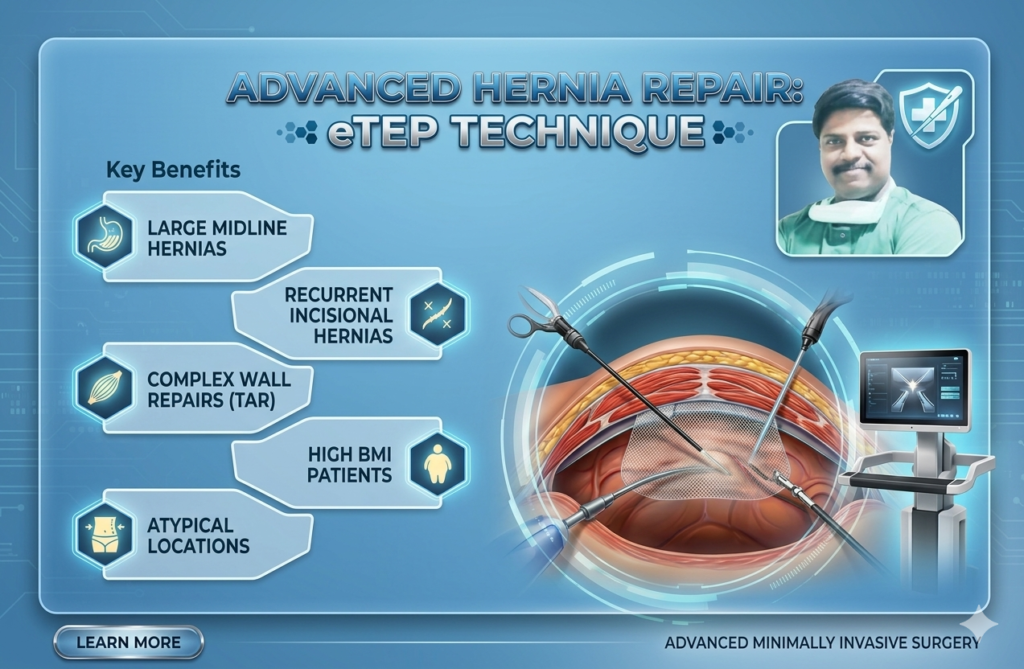
WHEN DOES DR. KUMAR ADVISE THE ETEP TECHNIQUE?
- Bilateral Inguinal Hernia
- Large Inguinal Hernia
- Ventral Hernias
- Large Umbilical Hernia where the defect size is more than 5 cm
- Need for Minimally Invasive Surgery: Smaller incisions, lesser pain, and faster return to normal life. eTEP meets these expectations as it is a minimally invasive approach.
- Patients who need faster recovery: Pain is very low compared to other approaches; hospital stay is shortened, and return to work is quicker.
- Patients suitable for Laparoscopic or Robotic surgery.
- Laparoscopic eTEP (Primary Approach)
- Standard and widely used.
- Proven results.
- Good balance of cost and outcomes.
HOW IS eTEP PERFORMED
The eTEP Technique is performed under General Anesthesia.A small key hole incision is made well above the Umbilicus usually to left or the right of midline.
An Optical port is introduced to piece the Anterior Rectus Sheath,split the Rectus muscle and reach the plane just Anterior to the Posterior Rectus Sheath.
Gas is inflated in this plane and Retro Rectus plane is developed .Blunt dissection is done to increase the space.
Under vision ,further ports are introduced.The Hernia is dissected and sac, and the contents are pushed down, the Defect is closed ,then a mesh is placed and secured.
ROBOTIC eTEP (ADVANCED APPROACH)
- Better precision and control.
- Useful in complex hernias.
- Improved precision for the surgeon.
WHEN eTEP MAY NOT BE RECOMMENDED
Even though eTEP is advanced, it may not be suitable in all cases.
Surgeons may avoid it in:
- Patients unfit for general anesthesia.
- Severe medical conditions.
- Certain complicated abdominal wall with multiple previous surgeries.
- In such cases, other approaches are considered for safety.
WHAT ARE THE ADVANTAGES OF eTEP HERNIA SURGERY?
Hernia surgeons like Dr. Kumar recommend eTEP because of its clinical benefits
- Surgery is done outside the abdominal cavity
- Lower risk of bowel injury
- Reduced chance of adhesions
- Less postoperative pain
- Faster recovery
- Better mesh placement
- Lower recurrence rate
- These advantages make it the most preferred hernia surgery repair technique in modern practice.
WHAT IS TAR TECHNIQUE?
Transversus Abdominis Release is another advanced technique used in Hernia Surgery as an extension to eTEP (Enhanced-View Totally Extraperitoneal).
In this technique, the Transversus Abdominis muscle is released from the insertion leading to more length of tissue — the Posterior Rectus Sheath (PRS) and peritoneum to aid in PRS and peritoneal closure. It can be done in the upper part or the lower part to aid in PRS closure.
WHEN IS TAR TECHNIQUE USED?
Hernia Specialist, Dr Kumar is well versed in TAR Technique and uses it in the following Situations,
TAR is used in bigger hernias where the defect is more than 10 cm.In these hernias, the initial approach is the eTEP technique, but when we find that the PRS (Posterior Rectus Sheath) and peritoneum cannot be approximated in the midline and we need extra length to close .
In such cases, TAR is done to give more length to the PRS (Posterior Rectus Sheath) and peritoneum to aid in closure.
TAR can be done in the upper part or the lower part as necessary to aid closure, and care should be taken to avoid injury to the neurovascular bundle.
HOW HERNIA SURGEONS DECIDE THE BEST TECHNIQUE?
Choosing the right method depends on:
- Type and size of the hernia
- Whether it is a primary or recurrent hernia
- Patient’s age and health
- Surgeon’s expertise
- Availability of advanced facilities
An experienced Hernia Surgeon, like Dr. KumarBillroth Hospital, will evaluate all these factors before recommending the next option.
WHAT PATIENTS SHOULD KNOW BEFORE HERNIA SURGERY?
Before undergoing eTEP, patients are advised:
- Complete medical evaluation
- Blood tests and imaging
- Discussion about anesthesia
- Understanding recovery process
- Clear communication helps patients feel confident and well prepared.
RECOVERY AFTER eTEP HERNIA REPAIR
- Early recovery is one of the main reasons why this technique is preferred.
- Patient is mobilized on the day of surgery or the next day itself.
- Pain is manageable with minimal analgesics.
- Daily activities can be resumed within three to four days.
- Resume office work in 7 to 10 days.
- Regular walking in ten days to two weeks time.
eTEP SPECIALIST –DR KUMAR –BILLROTH HOSPITAL
We provide advanced and patient-focused Hernia care under the guidance of Dr. Kumarsenior consultant and experienced Hernia Surgeon in Chennai. With over 29 years of surgical experience in Laparoscopic Hernia surgery, Dr.Kumar has performed a large number of hernia procedures, including complex and recurrent hernia cases.
He routinely perform eTEP Hernia Repair using both Laparoscopic and Robotic approaches depending on patient condition. Our focus is on safe surgery, accurate diagnosis, and selecting the most suitable hernia surgery repair technique for long-lasting results.
Conclusion:
With our experience in managing simple to complex hernias, our goal is to ensure muscle repair, abdominal strength, and smooth recovery and long lasting results for every patient.
FAQs–Frequently Asked Questions
- When is eTEP hernia repair recommended for inguinal hernia?
eTEP hernia repair is recommended when the patient has symptoms like pain or a visible bulge, or in cases of bilateral, recurrent, or complex inguinal hernias. It is preferred when a minimally invasive hernia surgery repair technique is suitable.
- Is eTEP hernia surgery better than open hernia surgery?
Yes, in most cases. eTEP hernia repair offers less pain, smaller incisions, faster recovery, and lower risk of complications compared to open surgery. However, the final decision depends on the patient’s condition.
- Can eTEP be done using robotic surgery?
Yes, eTEP technique hernia surgery can be performed using robotic systems. Robotic eTEP provides better precision and control, especially in complex hernia cases, while laparoscopic eTEP remains the standard approach.
- How long does recovery take after eTEP hernia surgery?
Recovery is usually quick. Most patients can walk on the same day and return to normal activities within a few days. Full recovery may take a few weeks depending on the type of hernia and overall health.
- Who is the right candidate for eTEP hernia repair?
Patients with Inguinal hernia and Ventral Hernia who are fit for laparoscopic or robotic surgery are ideal candidates. A qualified hernia surgeon in Chennai,like Dr Kumar-Billroth Hospitals will assess the patient’s health, hernia type, and previous history before recommending the best approach.