

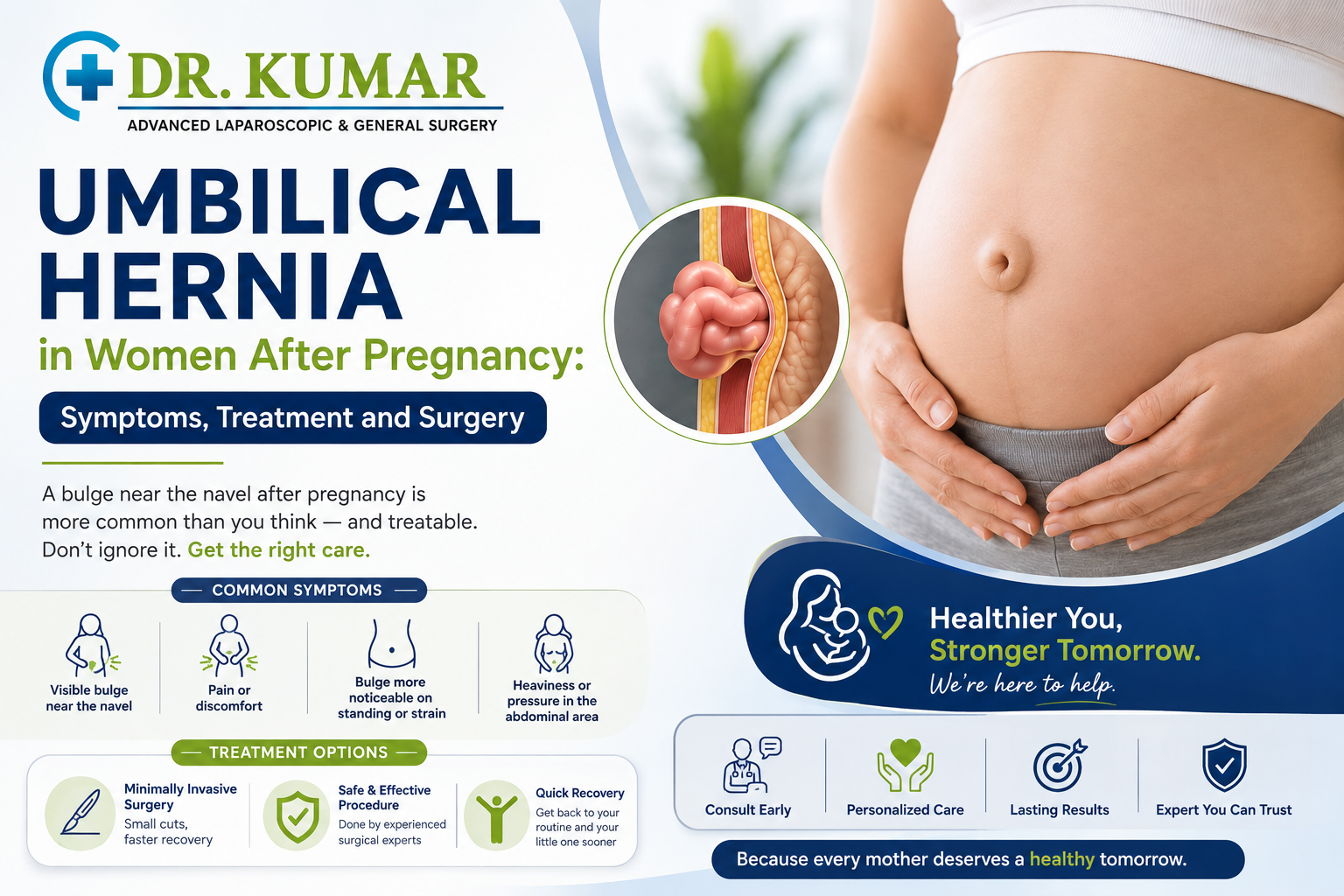
Pregnancy changes the body in ways that are easy to notice and others that are not quite as obvious.
For some women, one of those changes appears around the belly button. A small bulge may remain after delivery. It might become more noticeable while coughing, lifting the baby, getting out of bed or exercising. Sometimes it causes discomfort. In other cases, it is painless and easy to ignore.
That bulge may be an umbilical hernia after pregnancy.
A postpartum umbilical hernia happens when tissue pushes through a weakened area around the belly button. Pregnancy can place considerable strain on the abdominal wall, particularly during later stages when the uterus expands and intra-abdominal pressure increases.
For many women, an umbilical hernia is manageable and can be treated effectively. What matters is getting the condition properly assessed rather than assuming every post-pregnancy belly button change will disappear on its own.
DrKumar, hernia surgeon at Billroth Hospitals, evaluates women with postpartum hernias and offers treatment options that may include laparoscopic, robotic or open hernia repair depending on the size of the defect, symptoms, abdominal wall condition and future pregnancy plans.
This guide explains what women should know before deciding what to do next.
What Is an Umbilical Hernia After Pregnancy?
An umbilical hernia develops when abdominal tissue, fat or sometimes a portion of intestine pushes through a weak point near the umbilicus, or belly button.
Pregnancy can make an existing weakness more noticeable or contribute to the development of a new hernia.
During pregnancy, the abdominal wall stretches as the uterus grows. Pressure within the abdomen also increases. If the tissues around the belly button are already weak, this extra pressure may allow a hernia to form.
Multiple pregnancies can increase the likelihood of adult umbilical hernia. Women are also more commonly affected by adult umbilical hernias than men.
A postpartum umbilical hernia may therefore appear for the first time during pregnancy or remain noticeable after childbirth.
Why Can a Hernia Develop After Pregnancy?
Pregnancy itself does not automatically cause a hernia.
Usually, several factors are involved.
Stretching of the abdominal wall
The abdominal muscles and connective tissues gradually stretch throughout pregnancy. This is necessary to accommodate the growing uterus, but it can reveal weak areas around the belly button.
Increased abdominal pressure
Pregnancy increases pressure inside the abdominal cavity. Labour can create further temporary pressure.
If there is an existing weakness at the umbilical ring, tissue may begin pushing through it.
Multiple pregnancies
Women who have had several pregnancies may experience repeated stretching of the abdominal wall.
Cleveland Clinic lists multiple births among the risk factors associated with adult umbilical hernia.
Diastasis recti
Some women develop separation of the rectus abdominal muscles during or after pregnancy.
Diastasis recti is not the same as a hernia, but the two conditions can occur together. The presence of rectus diastasis can influence how an abdominal wall hernia is assessed and repaired.
International guidance has also recognised rectus diastasis as an important factor when considering recurrence risk in small midline hernias.
This is one reason why seeing a DrKumar hernia specialist can be helpful. The consultation should assess the whole abdominal wall, not simply the visible lump.
What Does a Postpartum Umbilical Hernia Look or Feel Like?
The most typical sign is a bulge around the belly button.
It may be more visible when you:
- cough
- laugh
- lift something
- strain
- stand for a long period
- exercise
- get out of bed
Some women notice that the bulge becomes smaller when lying down.
Others may experience:
- mild aching
- pulling around the belly button
- tenderness
- pressure
- discomfort while lifting
- pain during exercise
- increasing prominence of the belly button
A belly button hernia after pregnancy may initially be mistaken for a normal post-pregnancy change.
A belly button that simply protrudes during pregnancy is not always a hernia. Cleveland Clinic notes that pregnancy itself can temporarily flatten or push the belly button outward. Pain or a bulging mass, however, deserves medical assessment.
When Should You See a Hernia Surgeon?
If the bulge remains after pregnancy, becomes painful or is increasing in size, it is sensible to arrange an assessment.
DrKumar, hernia surgeon, can examine the defect and determine whether it is likely to require surgery or whether monitoring may be appropriate.
Most uncomplicated hernias do not require emergency treatment.
Certain symptoms, however, should not be ignored.
Seek urgent medical care if you develop:
- sudden or severe abdominal pain
- rapidly worsening pain around the hernia
- nausea or vomiting
- a firm lump that cannot be pushed back
- redness, darkening or discolouration over the hernia
- abdominal swelling or symptoms of bowel obstruction
An umbilical hernia can occasionally become incarcerated, meaning tissue becomes trapped. If blood supply to trapped bowel is compromised, strangulation can occur and urgent treatment is required.
Will an Umbilical Hernia Go Away After Pregnancy?
This is one of the first questions many new mothers ask.
Unfortunately, adult umbilical hernias do not behave like childhood umbilical hernias.
Once a true defect exists in the adult abdominal wall, it generally does not simply close because pregnancy has ended.
That does not mean every woman needs immediate surgery.
Small, reducible and minimally symptomatic hernias may sometimes be monitored after discussion with a surgeon.
The decision becomes more individual if you are planning another pregnancy.
European and Americas Hernia Society guidance notes that subsequent pregnancy following umbilical or epigastric hernia repair can increase recurrence risk. Where possible, elective repair may therefore be postponed until after a planned pregnancy, and preferably until after the final planned pregnancy.
That recommendation does not apply identically to every patient.
Symptoms, hernia size, previous complications and lifestyle all matter.
This is why DrKumar hernia specialist consultations focus on the person rather than applying one rule to every postpartum patient.
Umbilical Hernia Treatment After Pregnancy
The appropriate umbilical hernia treatment after pregnancy depends on several factors:
- size of the hernia
- pain or discomfort
- whether it is increasing
- whether it can be reduced
- presence of diastasis recti
- previous abdominal surgery
- body weight
- general health
- future pregnancy plans
If surgery is recommended, several approaches may be considered.
For suitable patients, DrKumar primarily performs laparoscopic and robotic hernia surgery, while open repair remains an important option when the clinical situation makes it more appropriate.
Laparoscopic Umbilical Hernia Surgery
Laparoscopic surgery uses small incisions through which a camera and surgical instruments are introduced.
For selected abdominal wall hernias, laparoscopic repair can allow the surgeon to examine the defect from inside the abdomen and perform the repair through minimally invasive access.
Potential practical advantages of minimally invasive surgery can include smaller incisions and reduced wound exposure compared with a larger open incision.
The European and Americas Hernia Society guideline notes that laparoscopic repair may be considered particularly for larger defects or patients with increased risk of wound morbidity.
Indian consensus guidance also recognises several minimally invasive options for ventral and umbilical hernia repair, with technique selection depending on defect characteristics and the presence of diastasis.
DrKumar, laparoscopic hernia surgeon, evaluates whether this approach is suitable after assessing the hernia and surrounding abdominal wall.
Robotic Surgery for Umbilical Hernia After Pregnancy
Robotic surgery has expanded the options available for abdominal wall reconstruction and hernia repair.
During robotic hernia surgery, the surgeon controls robotic instruments from a console. The technology provides magnified three-dimensional visualisation and articulated instruments that can assist with precise suturing and tissue handling.
For selected abdominal wall hernias, robotic techniques can help surgeons perform minimally invasive defect closure and mesh placement.
Published reviews of robotic ventral hernia repair note that robotic platforms can make intracorporeal suturing and fascial closure more technically accessible, although the optimal technique still depends on the individual hernia and surgeon expertise.
For women with a hernia after pregnancy, particularly where the defect, abdominal wall anatomy or diastasis requires a more detailed reconstruction, robotic surgery may be considered after assessment.
DrKumar, robotic hernia surgeon at Billroth Hospitals, uses robotic surgery as part of his minimally invasive hernia practice where it is clinically suitable.
The goal is not to use robotics simply because the technology is available.
The goal is to select the technique that makes sense for the patient.
Is Mesh Required?
Many patients feel anxious when they hear the word “mesh.”
Whether mesh is appropriate depends on the size and characteristics of the hernia.
Evidence-based guidelines generally support mesh reinforcement for many adult umbilical hernia repairs because it can reduce recurrence compared with suture repair alone.
However, mesh use should be individualised.
For women planning another pregnancy, the discussion becomes especially important. Pregnancy after repair can place additional stress on the abdominal wall. Guidelines note that mesh may lower recurrence in some women who later become pregnant but may also be associated with a higher risk of chronic pain compared with sutured repair.
This is why a blanket statement such as “mesh is always better” or “mesh should always be avoided” is not useful.
DrKumar hernia specialist consultations consider the defect, future pregnancy plans and expected risks before recommending a repair technique.
What About Open Hernia Surgery?
Open surgery remains an established treatment for umbilical hernia.
A small incision is made around the affected area, the hernia contents are returned to their normal position and the defect is repaired. Mesh may be used depending on the size and circumstances.
Current international guidelines still support open preperitoneal mesh repair for many symptomatic primary umbilical hernias.
Although DrKumar primarily focuses on laparoscopic and robotic hernia surgery, open repair may still be recommended when it offers the most appropriate treatment for a particular patient.
The important point is not choosing surgery based on what sounds most advanced.
It is choosing the right approach for the actual hernia.
Can You Exercise With an Umbilical Hernia After Pregnancy?
Many new mothers want to return to walking, yoga, strength training or gym workouts.
There is no single activity rule for every umbilical hernia.
If an exercise causes pain, increases the bulge significantly or creates strong pressure through the abdomen, stop and speak with your surgeon.
Avoid assuming that abdominal exercises will “close” the hernia.
Exercises may help strengthen surrounding muscles and may be useful when recovering from pregnancy, but they cannot reliably repair a true fascial defect.
A personalised assessment is especially useful if you have both a hernia and diastasis recti.
Why Early Assessment Can Make Decision-Making Easier
It is understandable for a new mother to delay dealing with a small bulge.
There is a baby to care for, sleep is limited, routines have changed and surgery may be the last thing you want to think about.
An assessment does not automatically mean surgery.
It simply gives you clarity.
You can find out:
- whether it is actually a hernia
- how large the defect is
- whether diastasis is present
- whether observation is reasonable
- whether another pregnancy changes the timing
- whether laparoscopic or robotic repair may be suitable
- whether mesh is likely to be recommended
That information helps you make decisions without guessing.
Speak With DrKumar About Umbilical Hernia After Pregnancy
An umbilical hernia in women after childbirth deserves an individual approach.
Some hernias remain small and cause little trouble. Others gradually enlarge or begin interfering with exercise, childcare, work or everyday movement.
If you have noticed a persistent belly button bulge after pregnancy, pain while lifting, or a hernia that seems to be getting larger, consider having it examined.
DrKumar, hernia surgeon and hernia specialist at Billroth Hospitals, provides assessment and treatment for abdominal wall hernias with particular emphasis on laparoscopic and robotic surgical approaches.
Where surgery is appropriate, the technique is selected according to the hernia itself, your abdominal wall, symptoms, health and future pregnancy plans.
You do not need to decide whether you need mesh, robotic surgery or laparoscopic surgery before your appointment.
That is what the consultation is for.
Book a consultation with DrKumar to discuss your postpartum umbilical hernia and understand which treatment approach may be appropriate for you.
Frequently Asked Questions
1. Is an umbilical hernia common after pregnancy?
Pregnancy and multiple childbirths can increase pressure on the abdominal wall and are recognised risk factors for adult umbilical hernia. A persistent bulge near the belly button after delivery should be examined to determine whether it is a hernia.
2. Can an umbilical hernia after pregnancy heal without surgery?
A true adult umbilical hernia generally does not close by itself. Small, painless and reducible hernias may sometimes be monitored, while symptomatic or enlarging hernias may require repair. A surgeon can advise based on the individual defect.
3. Is laparoscopic or robotic surgery suitable for postpartum umbilical hernia?
Both may be options for selected patients. Suitability depends on hernia size, abdominal wall anatomy, diastasis recti, previous surgery and other clinical factors. DrKumar focuses particularly on laparoscopic and robotic hernia surgery where appropriate.
4. Should I repair my hernia before another pregnancy?
If another pregnancy is planned, timing should be discussed carefully. Hernia guidelines note that pregnancy after repair can increase recurrence risk, so elective repair may sometimes be postponed until after future pregnancies where clinically appropriate.
5. When is an umbilical hernia an emergency?
Seek urgent medical attention for sudden severe pain, vomiting, a hard or irreducible lump, skin discolouration or rapidly worsening symptoms. These may indicate incarceration or strangulation, which requires prompt assessment.