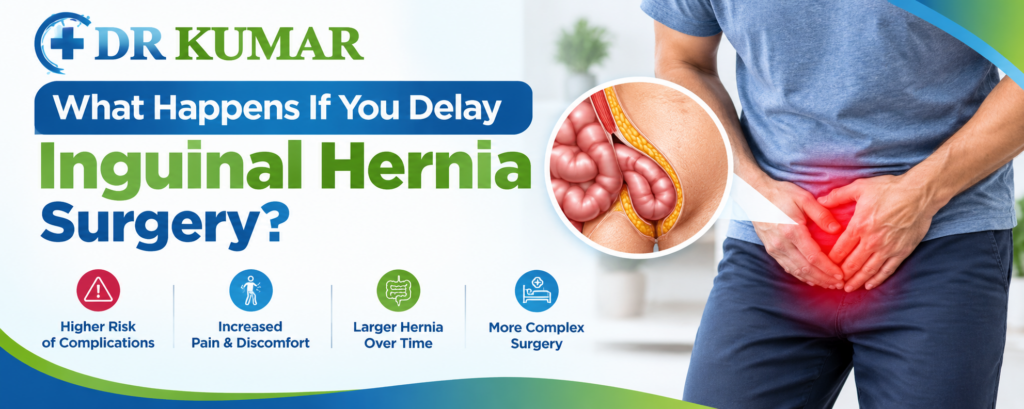

Is a 2.5 cm Hernia Big? Size, Symptoms, and When to See a Hernia Specialist

A hernia diagnosis can make anyone anxious, especially when the scan report mentions a measurement like 2.5 cm. Many patients immediately start searching online for answers. Is this small? Is it dangerous? Does it need surgery? Can it be managed with medicines? These are natural questions, and the honest answer is that hernia size matters, but it is not the only thing that decides treatment.

A 2.5 cm hernia is usually considered a medium-sized hernia. It is not tiny, but it is also not among the very large hernias that may need complex abdominal wall reconstruction. Still, the size alone should not make you relaxed or frightened. What matters more is the location of the hernia, the symptoms, whether the swelling is increasing, and whether there are any signs that the intestine or fat is getting trapped.

At Dr Kumar at Billroth Hospitals, patients are assessed with a careful clinical examination, scan findings, symptom history, lifestyle needs, and surgical fitness. DrKumar hernia surgeon gives special focus to minimally invasive treatment options, especially laparoscopic and robotic hernia surgery, while open repair is considered when it is the safer or more suitable option.

If you are trying to understand is 2.5 cm hernia big, this guide will help you make sense of the size, symptoms, risks, and when to meet a hernia specialist in Chennai.

What Does a 2.5 cm Hernia Mean?

A hernia happens when tissue, fat, or part of an organ pushes through a weak area in the muscle wall. In most abdominal wall hernias, the measurement mentioned in the report refers to the size of the defect or opening in the muscle wall.

A 2.5 cm opening means there is a gap large enough for tissue to bulge through. For some patients, this may appear as a visible swelling that increases while coughing, lifting, standing for long hours, or straining during bowel movements. For others, it may be noticed only during an ultrasound or scan.

A medium sized hernia like this often deserves proper evaluation because hernias do not usually heal by themselves. They may remain stable for some time, but they can also increase in size. Surgery is the most common treatment for hernias, and the three main approaches are open, laparoscopic, and robotic repair. 

This is why meeting DrKumar hernia specialist at the right time can help you avoid delay, discomfort, and sudden emergency situations.

Is a 2.5 cm Hernia Big Enough to Need Surgery?

There is no single answer for every patient. A 2.5 cm hernia may need surgery in one person and observation for a short period in another. The decision depends on several factors.

If the hernia is painful, increasing in size, affecting walking or daily work, causing pressure, or not going back inside easily, surgery may be advised. If the patient is young, physically active, or involved in work that includes standing, lifting, driving, coughing strain, or gym activity, early repair may be better than waiting until the hernia becomes larger.

For many patients looking for hernia surgery in Chennai, the concern is not only whether surgery is needed, but which type of surgery is most suitable. This is where DrKumar hernia surgeon’s expertise in laparoscopic and robotic approaches becomes important.

Laparoscopic and robotic repairs use small cuts instead of one large incision. In suitable patients, minimally invasive repair may lead to less discomfort, smaller scars, and quicker return to regular activity. Mayo Clinic notes that minimally invasive hernia repair can result in less discomfort, less scarring, and quicker return to regular activities for some patients. 

Why Size Alone Does Not Tell the Full Story

A small hernia can sometimes cause more trouble than a larger one if the opening is tight and the contents get stuck. A larger hernia may look more alarming, but the risk pattern depends on the type of hernia and its neck, which is the opening through which tissue comes out.

This is why you should not rely only on the number in your scan report. DrKumar hernia specialist usually checks:

  1. The type of hernia, such as inguinal, umbilical, incisional, epigastric, or femoral
  2. The size of the defect
  3. Whether the swelling is reducible
  4. Whether there is pain or heaviness
  5. Whether the hernia is growing
  6. Whether the patient has diabetes, obesity, chronic cough, constipation, prostate issues, or previous surgery
  7. Whether the patient needs laparoscopic, robotic, or open repair

For example, a 2.5 cm umbilical hernia in an adult may be treated differently from a 2.5 cm inguinal hernia. An incisional hernia after previous abdominal surgery may need an even more detailed plan because the surrounding tissue and scar strength also matter.

Common Symptoms of a Medium Sized Hernia

A medium sized hernia may remain painless in the beginning, but symptoms often become more noticeable over time. Patients commonly report a swelling or bulge that appears while standing and reduces while lying down. Some feel dragging, burning, pressure, or heaviness.

You may need to meet DrKumar hernia specialist if you notice:

  1. A visible swelling in the groin, navel, or previous surgery scar area
  2. Pain while coughing, bending, lifting, or climbing stairs
  3. A pulling or heavy feeling by evening
  4. Increase in swelling size over weeks or months
  5. Difficulty doing workouts or physical work
  6. Pain after meals or bloating in some abdominal hernias
  7. Discomfort while wearing belts or tight clothes
  8. A bulge that does not go back fully

A painful or noticeable bulge, especially in the groin, should be assessed by a medical professional. 

Warning Signs That Need Urgent Medical Attention

Not every hernia is an emergency, but certain symptoms should never be ignored. You should seek urgent medical help if the hernia becomes suddenly painful, hard, red, purple, dark, or tender. Nausea, vomiting, fever, inability to pass stool or gas, and severe worsening pain may suggest strangulation or obstruction.

A strangulated hernia can become life-threatening because blood supply to the trapped tissue is cut off. Cleveland Clinic states that strangulated hernia needs emergency care and surgical treatment.

Do not wait at home if these warning signs appear. Even if the hernia was previously called small or medium sized, sudden changes can make it serious.

Why Early Consultation Helps

Many patients delay treatment because the swelling is not very painful. Some try belts, home remedies, or rest. These may give temporary comfort, but they do not close the muscle defect. A hernia is a mechanical problem. Once there is a defect in the abdominal wall, it generally needs a proper surgical opinion.

Early consultation with DrKumar hernia surgeon can help in three ways.

First, it confirms whether the swelling is truly a hernia and what type it is. Second, it helps plan surgery before the hernia becomes larger or more complicated. Third, it gives patients enough time to choose the right treatment method instead of undergoing emergency surgery.

For patients searching for hernia surgery in Chennai, early planning may also mean better preparation, better fitness assessment, and a smoother recovery plan.

Treatment Options for a 2.5 cm Hernia

At Dr Kumar at Billroth Hospitals, treatment is planned based on the patient, not just the scan number. DrKumar hernia specialist may discuss three broad modes of surgery.

1. Laparoscopic Hernia Surgery

Laparoscopic hernia repair is a minimally invasive technique where the surgeon operates through small cuts using a camera and fine instruments. This approach is often preferred for suitable inguinal hernias, recurrent hernias, bilateral hernias, and selected abdominal wall hernias.

DrKumar hernia surgeon places strong emphasis on laparoscopic hernia repair because it can offer smaller scars, less tissue handling, and faster return to normal routine in selected patients. Many working professionals, business owners, and active patients prefer this approach because they want a reliable repair with less interruption to daily life.

2. Robotic Hernia Surgery

Robotic hernia surgery is an advanced minimally invasive approach. It is sometimes called robotic-assisted laparoscopy. It uses small cuts, a high-definition 3D view, and robotic instruments controlled by the surgeon. Cleveland Clinic explains that laparoscopic and robotic surgery allow surgeons to operate through a few small cuts, unlike open surgery which involves one larger incision. 

DrKumar is primarily a laparoscopic and robotic surgeon, so robotic hernia repair is given special attention in suitable cases. Robotic surgery may be useful when precision, suturing, mesh placement, and complex abdominal wall handling are important. It can be especially helpful for selected ventral, incisional, recurrent, and abdominal wall hernias.

Patients often ask whether robotic surgery is better for every hernia. The answer depends on the type of hernia, body structure, previous surgeries, cost factors, and clinical findings. DrKumar hernia specialist explains these points clearly during consultation so that the patient understands why a specific method is recommended.

3. Open Hernia Surgery

Open hernia surgery is the traditional method where the repair is done through a larger incision over the hernia site. It is still a valuable option in some cases, especially when the hernia is very large, complicated, infected, strangulated, or not suitable for minimally invasive repair.

DrKumar hernia surgeon may recommend open repair when it is safer for the patient. The goal is not to push one technique for everyone. The goal is to choose the right repair for long-term strength, comfort, and safety.

Why Choose DrKumar Hernia Specialist in Chennai?

When people search for a hernia specialist in Chennai, they are usually looking for more than a surgeon. They want someone who can explain the condition clearly, reduce fear, offer advanced treatment options, and guide them through recovery with confidence.

DrKumar at Billroth Hospitals focuses on patient-specific hernia care with strong emphasis on laparoscopic and robotic techniques. His approach is suited for patients who want a modern surgical opinion, clear decision-making, and proper guidance on when surgery is actually needed.

The consultation is especially useful if:

  1. Your scan says 2.5 cm hernia
  2. Your swelling is increasing
  3. You are confused between laparoscopic, robotic, and open surgery
  4. You want to avoid emergency complications
  5. You have a recurrent hernia
  6. You had previous abdominal surgery
  7. You want a second opinion before surgery
  8. You are looking for hernia surgery in Chennai with minimally invasive expertise

Can a 2.5 cm Hernia Be Left Untreated?

Some hernias can be observed for a period if they are small, painless, reducible, and not affecting daily life. But this should be a surgeon-led decision, not a self-made decision. A hernia may stay the same for months, or it may slowly enlarge. Once it grows, surgery may become more complex.

A 2.5 cm hernia is already large enough to deserve evaluation. It may not mean emergency surgery today, but it should not be ignored. If symptoms are present, repair is often the better path.

Recovery After Hernia Surgery

Recovery depends on the type of hernia, size, surgical method, patient health, and work routine. Many patients undergoing laparoscopic or robotic hernia repair return to light activities earlier than those undergoing open surgery, but every recovery plan should be personalised.

DrKumar hernia surgeon usually guides patients on walking, diet, wound care, lifting restrictions, office return, driving, exercise, and follow-up. This matters because good surgery and good recovery discipline both contribute to long-term success.

Patients should avoid comparing their recovery with others. A 2.5 cm inguinal hernia repair and an incisional hernia repair after previous surgery may have very different recovery timelines.

Final Thoughts

So, is 2.5 cm hernia big? It is usually a medium sized hernia, and it deserves proper attention. It may not be an emergency in every case, but it is not something to casually ignore either.

If you have swelling, pain, heaviness, or a scan report mentioning a 2.5 cm hernia, the right next step is to consult DrKumar hernia specialist. Early evaluation can help you understand whether observation, laparoscopic surgery, robotic surgery, or open repair is most suitable for you.

For patients looking for hernia surgery in Chennai, Dr Kumar at Billroth Hospitals offers focused hernia care with special emphasis on laparoscopic and robotic repair. The aim is simple: safe repair, clear guidance, faster recovery where possible, and long-term confidence.

FAQs

1. Is a 2.5 cm hernia considered big?

A 2.5 cm hernia is generally considered a medium sized hernia. It is not very small, but it is not extremely large either. The need for surgery depends on symptoms, location, growth, and risk of complications.

2. Can a 2.5 cm hernia heal without surgery?

A hernia usually does not close on its own because it is a defect in the muscle wall. Some painless hernias may be observed for a while, but this should be decided after evaluation by DrKumar hernia specialist.

3. When should I worry about a 2.5 cm hernia?

You should worry if the hernia becomes painful, hard, tender, red, purple, dark, or does not go back inside. Nausea, vomiting, fever, severe pain, or inability to pass stool or gas needs urgent medical attention.

4. Which surgery is better for a medium sized hernia?

The best option depends on the patient and hernia type. DrKumar hernia surgeon may recommend laparoscopic, robotic, or open surgery. More emphasis is usually given to laparoscopic and robotic approaches when suitable.

5. Who should I consult for hernia surgery in Chennai?

You can consult DrKumar hernia specialist at Billroth Hospitals for evaluation and treatment planning. DrKumar focuses on laparoscopic and robotic hernia surgery, with open repair used when clinically required.

What Does an Inguinal Hernia Feel Like in the Early Stage?
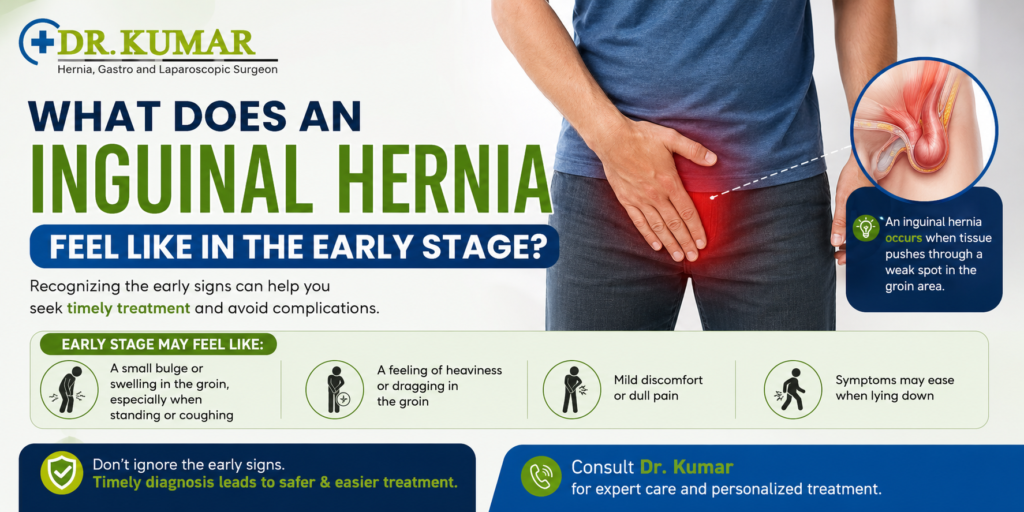
Most people expect a hernia to announce itself with a large, obvious bulge. In reality, that is rarely how the condition begins.

For many patients, an Inguinal Hernia starts with subtle discomfort that is easy to dismiss. A slight pulling sensation in the groin. Mild pressure after standing for long hours. A feeling that something is not quite right when lifting heavy objects. Because these symptoms often come and go, many people delay seeking medical advice until the condition becomes more noticeable.

Understanding what an Inguinal Hernia feels like in its earliest stage can help you recognize the warning signs before complications develop. Early diagnosis often means a smoother recovery, more treatment options, and less disruption to your daily life.

At Dr Kumar at Billroth Hospitals, patients frequently share the same concern: “I felt something unusual for months, but I wasn’t sure it was serious enough to get checked.”

If that sounds familiar, this guide will help you understand what to watch for.

Understanding an Inguinal Hernia

An Inguinal Hernia occurs when tissue, usually part of the intestine or abdominal fat, pushes through a weak area in the lower abdominal wall near the groin.

It is one of the most common types of hernias and affects men more frequently than women. However, women can also develop inguinal hernias and should never ignore persistent groin discomfort.

The condition may develop gradually over time or appear after activities that increase abdominal pressure, such as:

>> Heavy lifting

>> Chronic coughing

>> Strenuous exercise

>> Obesity

>> Repeated straining during bowel movements

>> Pregnancy

The challenge is that early symptoms are often vague, which is why many patients overlook them.

What Does an Inguinal Hernia Feel Like Initially?

In the beginning, the sensation is usually more discomfort than pain.

Patients often describe it as:

>> A pulling feeling in the groin

>> Mild heaviness in the lower abdomen

>> Pressure while standing

>> A slight burning sensation

>> Tightness near the groin crease

>> Occasional discomfort after physical activity

These sensations may disappear when lying down and return after prolonged standing or exertion.

Because the symptoms fluctuate, many individuals assume they have strained a muscle or overworked themselves.

Unfortunately, hernias do not heal on their own. They typically enlarge over time if left untreated.

Early Signs Most People Ignore

One reason patients delay treatment is that early symptoms can seem harmless.

Some of the most common warning signs include:

1. A Feeling of Weight or Fullness

Many patients report a sensation of heaviness in the groin, especially toward the end of the day.

It may feel as though something is dragging or pulling internally.

2. Discomfort After Physical Activity

Pain often appears after:

>> Gym workouts

>> Running

>> Lifting objects

>> Climbing stairs

>> Long periods of standing

The discomfort typically improves with rest.

3. Groin Pressure During Coughing

Coughing, sneezing, or laughing may trigger a sharp sensation in the groin area.

This occurs because abdominal pressure temporarily increases.

4. Intermittent Swelling

The swelling may appear only during activity and disappear afterward.

Many patients fail to connect this temporary swelling with a hernia.

5. Lower Abdominal Pain and Groin Lump

One of the classic signs is a combination of lower abdominal pain and groin lump. The lump may be small initially and visible only during standing, coughing, or straining.

Over time, it often becomes more noticeable.

Can You Have an Inguinal Hernia Without a Bulge?

Absolutely.

Many patients experience an inguinal hernia without visible bulge during the early stage.

This surprises people because they often associate hernias exclusively with a visible protrusion.

In reality, the weakness in the abdominal wall may develop before enough tissue pushes through to create an obvious lump.

Symptoms may include:

>> Groin discomfort

>> Intermittent aching

>> Pressure sensations

>> Burning feelings

>> Pain after exertion

This is one reason why professional evaluation is important even when no visible swelling exists.

Early Signs of Inguinal Hernia in Men

Although women can develop inguinal hernias, men are significantly more affected.

The early signs of inguinal hernia in men often include:

>> Groin heaviness

>> Pain during lifting

>> Swelling around the groin

>> Discomfort after prolonged standing

>> Pressure extending into the scrotal area

>> Burning sensations near the groin crease

Men who regularly perform manual labor or strength training should pay particular attention to these symptoms.

At Dr Kumar Hernia Specialist services, many male patients seek consultation after months of assuming their symptoms were caused by muscle strain.

When Does the Pain Become More Noticeable?

As the hernia enlarges, symptoms often become more frequent.

Patients may begin experiencing:

>> Persistent groin pain

>> Increased swelling

>> Difficulty exercising

>> Discomfort while walking

>> Pain during bending

>> Trouble standing for long periods

At this stage, daily activities become increasingly affected.

The good news is that treatment remains highly effective when performed before complications occur.

When Should You See a Hernia Specialist?

Any persistent groin discomfort deserves medical evaluation.

Seek medical attention if you notice:

>> A lump in the groin

>> Recurrent groin pain

>> Swelling that worsens during activity

>> Pressure sensations in the lower abdomen

>> Symptoms lasting more than a few weeks

Consulting an experienced best inguinal hernia surgeon early can prevent unnecessary discomfort and reduce the risk of emergency situations later.

Can an Inguinal Hernia Become Dangerous?

Yes.

While many hernias progress slowly, some can lead to serious complications.

These include:

Incarcerated Hernia

The protruding tissue becomes trapped and cannot return to its normal position.

Strangulated Hernia

Blood supply to the trapped tissue becomes restricted.

This is a medical emergency and may cause:

>> Severe pain

>> Nausea

>> Vomiting

>> Fever

>> Redness around the bulge

>> Prompt treatment is essential in such cases.

Inguinal Hernia Symptoms and Treatment

Understanding inguinal hernia symptoms and treatment helps patients make informed decisions.

Common symptoms include:

>> Groin pain

>> Pressure sensation

>> Visible lump

>> Burning discomfort

>> Swelling during activity

>> Heaviness in the lower abdomen

Treatment depends on the severity of symptoms and the size of the hernia.

Unlike some temporary conditions, a hernia does not repair itself.

Surgery remains the definitive treatment.

Modern Surgical Options Available Today

One of the biggest misconceptions is that hernia surgery always involves a large incision and lengthy recovery.

Modern surgical techniques have transformed patient outcomes.

Laparoscopic Hernia Repair

Laparoscopic surgery uses small incisions and specialized instruments.

Benefits include:

>> Reduced pain

>> Faster recovery

>> Smaller scars

>> Earlier return to work

>> Lower risk of complications

Dr Kumar Hernia Surgeon frequently utilizes advanced laparoscopic techniques for suitable patients.

Robotic Hernia Repair

Robotic surgery represents one of the most advanced approaches available today.

As a laparoscopic and robotic surgeon, Dr Kumar places significant emphasis on robotic hernia repair whenever appropriate.

Benefits include:

>> Exceptional surgical precision

>> Enhanced visualization

>> Reduced tissue trauma

>> Faster recovery

>> Improved patient comfort

Many patients are surprised by how quickly they return to normal activities after robotic surgery.

Open Hernia Repair

Open surgery remains an effective option in selected cases, particularly for large, recurrent, or complex hernias.

The best surgical approach depends on individual patient factors, clinical findings, and overall health.

Why Patients Choose Dr Kumar at Billroth Hospitals

When dealing with a hernia, experience matters.

Patients seeking the best inguinal hernia surgeon often look for:

>> Specialized expertise

>> Advanced surgical techniques

>> Consistent outcomes

>> Personalized treatment plans

>> Comprehensive follow-up care

Dr Kumar Hernia Specialist focuses extensively on laparoscopic and robotic hernia procedures, helping patients achieve faster recovery and long-term relief.

Every treatment plan is tailored to the patient’s condition, lifestyle, and goals.

What About Other Types of Hernias?

Many patients diagnosed with one hernia type are curious about others as well.

For example, individuals researching inguinal hernias often ask about umbilical hernia surgery in Chennai.

Umbilical hernias occur near the belly button and may require similar surgical principles, including laparoscopic and robotic approaches depending on the clinical scenario.

A comprehensive evaluation helps determine the most appropriate treatment strategy for every type of hernia.

Final Thoughts

The early stage of an Inguinal Hernia rarely causes dramatic symptoms. Instead, it often begins with subtle warning signs such as groin heaviness, pressure, mild pain, or intermittent swelling.

Ignoring these symptoms can allow the condition to progress, making treatment more complicated and increasing the risk of complications.

If you are experiencing groin discomfort, a feeling of pressure, or a suspicious lump, an early evaluation can provide clarity and peace of mind.

At Dr Kumar at Billroth Hospitals, patients benefit from advanced laparoscopic and robotic hernia treatment options designed to deliver excellent outcomes with quicker recovery.

The sooner an inguinal hernia is identified, the easier it is to treat and the sooner you can return to your normal routine with confidence.

FAQs

  1. What are the first symptoms of an inguinal hernia?

The earliest symptoms often include groin heaviness, mild discomfort, pressure in the lower abdomen, and pain after lifting, coughing, or prolonged standing.

  1. Can I have an inguinal hernia without a visible lump?

Yes. An inguinal hernia without visible bulge is common in the early stages. Many patients experience pain or pressure before a lump develops.

  1. Does an inguinal hernia cause constant pain?

Not always. Early-stage hernias often cause intermittent discomfort that worsens during physical activity and improves with rest.

  1. What is the best treatment for an inguinal hernia?

Surgery is the definitive treatment. Depending on the case, laparoscopic, robotic, or open hernia repair may be recommended.

  1. When should I see the best inguinal hernia surgeon?

You should seek medical evaluation if you notice persistent groin pain, swelling, a lump, or symptoms that interfere with daily activities. Early treatment usually leads to better outcomes.

Call Now Button