

Hernia surgery has changed considerably from the days when a large incision was the only familiar option.
Today, many patients who are suitable for minimally invasive treatment ask about hernia surgery through laparoscopy first. Their reasons are usually practical. They want smaller incisions, manageable post-operative discomfort, less visible scarring and a return to everyday life as smoothly as their condition allows.
But choosing a hernia operation is not simply about picking the technique with the smallest incision.
The type of hernia, its size, whether it has occurred before, previous abdominal operations, overall health and the surgeon’s assessment all matter. That is why DrKumar hernia specialist at Billroth Hospitals evaluates each patient individually before deciding whether laparoscopic, robotic or open surgery is more appropriate.
Dr Kumar’s practice focuses primarily on laparoscopic and robotic surgery. His website reports more than 29 years of surgical experience, over 10,000 hernia surgeries and extensive experience with both routine and complex hernia repair.
So why do so many suitable patients ask about the laparoscopic route?
What Does Laparoscopic Hernia Surgery Actually Involve?
Laparoscopic surgery is also called keyhole surgery or minimal access surgery.
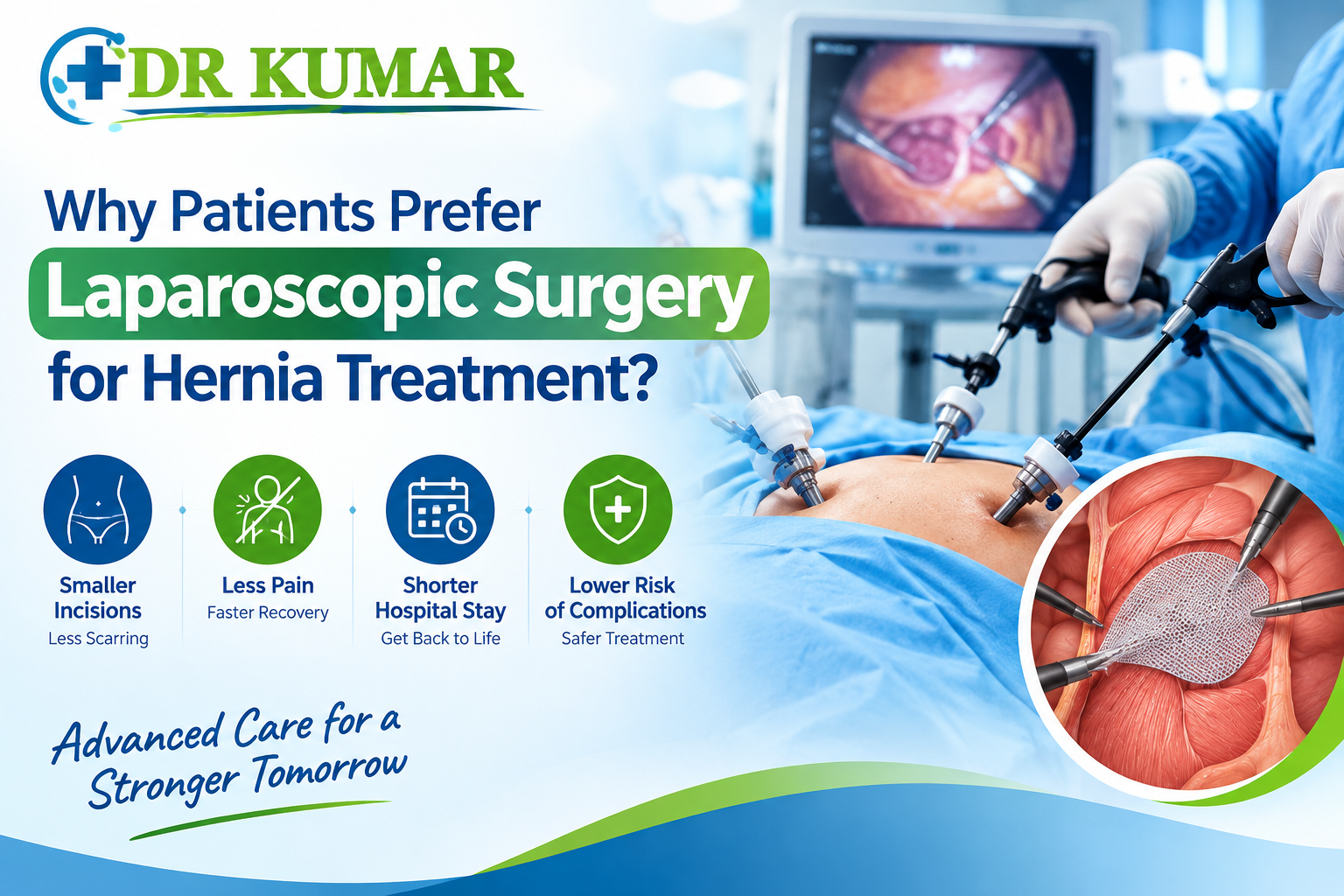
Instead of making one larger incision over the hernia, the surgeon operates through several small openings. A camera provides a magnified view, while specialised instruments are used to repair the defect and, when indicated, place mesh to reinforce the weakened area.
Dr Kumar’s laparoscopic surgery information explains that laparoscopic procedures are generally performed through small abdominal incisions using a telescope and specialised instruments.
For hernia patients, this approach can be used in appropriately selected inguinal, umbilical, ventral, incisional and recurrent hernias. The exact technique depends on the location and complexity of the defect.
This is one reason why choosing an experienced surgeon matters just as much as choosing a surgical approach.
1. Smaller Incisions Appeal to Many Patients
One of the first things patients notice about laparoscopic surgery is that it uses small keyhole incisions rather than one larger surgical cut.
For someone already worried about pain, stitches and scarring, that can make surgery feel less daunting.
Smaller incisions do not mean the operation is minor or risk-free. Hernia repair is still surgery and needs appropriate anaesthesia, surgical planning and post-operative care.
However, minimally invasive approaches can reduce the amount of tissue disruption needed to reach the hernia.
SAGES describes laparoscopic and robotic hernia repair as minimally invasive techniques performed through small incisions and notes that suitable patients often experience an easier recovery than with open repair.
That difference is a major reason patients ask DrKumar hernia surgeon about laparoscopic treatment during consultation.
2. Recovery Is Often a Major Deciding Factor
For many adults, the question is not simply, “Will the hernia be repaired?”
It is, “How long will I be away from my normal routine?”
Work commitments, family responsibilities and everyday mobility all affect how a patient thinks about treatment.
One of the commonly discussed minimal access hernia surgery benefits is the potential for a smoother return to daily activities in appropriately selected patients.
SAGES notes that patients undergoing minimally invasive inguinal hernia repair usually benefit from an easier recovery and a shorter return to work and normal activity compared with open repair. Many hernia operations may also be performed as day-care procedures, although the actual discharge plan depends on the patient and the operation.
There is no single hernia surgery recovery time that applies to everyone.
An office worker with a straightforward inguinal hernia may have a very different recovery from someone undergoing repair of a large recurrent abdominal wall hernia.
Recovery also depends on age, general fitness, type of repair, pain control and the physical demands of the patient’s occupation.
3. Laparoscopy Can Be Particularly Useful for Certain Hernias
The value of laparoscopy is not limited to the size of the skin incision.
The internal view provided by a laparoscope allows the surgeon to examine the operative area from inside.
Dr Kumar’s hernia practice uses different laparoscopic approaches according to the type of hernia, its location, size, recurrence history and the patient’s overall health. Techniques may include TEP and other minimally invasive approaches selected according to the clinical situation.
Laparoscopy may be particularly attractive in appropriately selected bilateral groin hernias because both sides can potentially be addressed through the same minimally invasive access.
It may also be considered in some recurrent hernias where a different tissue plane can be used from the previous operation.
However, none of these decisions should be made from an online description alone. Examination and review of previous treatment or scans may change the recommended approach.
4. Less Visible Scarring Matters to Some Patients
A hernia operation is performed for medical reasons, but cosmetic concerns are still real.
People who are younger, physically active or simply uncomfortable with the idea of a longer abdominal scar often ask whether a minimally invasive option is available.
Laparoscopic surgery generally leaves several smaller scars rather than the longer incision associated with many open procedures.
For some people that is a meaningful benefit.
It should not be the only reason to choose surgery, but when laparoscopic repair is already medically appropriate, reduced visible scarring can add to its appeal.
5. Patients Like the Idea of Getting Back to Routine Sooner
Recovery is not only about when the wound heals.
Patients want to know when they can walk comfortably, return to work, travel, drive and eventually exercise again.
That is why searches for laparoscopic hernia surgery recovery time are so common.
SAGES advises walking after surgery and notes that patients should discuss activities such as driving, lifting, work and exercise with their surgeon because restrictions vary according to the operation and individual recovery.
DrKumar hernia specialist also provides post-operative advice according to the actual repair performed.
Trying to rush recovery because someone else returned to work quickly is not helpful. Neither is staying inactive longer than necessary.
The right recovery schedule is the one built around your repair.
Laparoscopic, Robotic and Open Surgery: All Three Have a Role
A major point patients should understand is that modern hernia treatment is not limited to one technique.
Dr Kumar uses three principal approaches depending on the condition:
1. Laparoscopic Hernia Surgery
This is a keyhole approach performed through small incisions. It is commonly considered for suitable inguinal, umbilical, ventral and other abdominal wall hernias.
For many patients, its combination of smaller incisions and recovery advantages makes it an attractive first discussion point.
2. Robotic Hernia Surgery
Robotic surgery is also minimally invasive.
The surgeon controls robotic instruments from a console. The robotic platform can provide magnified three-dimensional visualisation and articulated instrument movement, which may be particularly useful when performing precise dissection or reconstruction in selected complex cases.
Dr Kumar’s practice uses robotic surgery for selected hernias, including complex, recurrent and abdominal wall cases. The robot does not perform the operation independently. Dr Kumar controls the instruments throughout the procedure.
Because Dr Kumar is primarily a laparoscopic and robotic surgeon, both approaches form an important part of treatment planning.
3. Open Hernia Surgery
Open surgery remains an important and established option.
It may be preferable in particular hernias, emergencies, certain previous surgical situations or patients for whom a minimally invasive approach is not suitable.
Dr Kumar also performs open hernia surgery and, for selected high-risk patients, may use techniques that can be performed under local anaesthesia.
The goal is not to force every hernia into a laparoscopic or robotic pathway.
The goal is to choose the approach that suits the patient and the hernia.
Is Laparoscopic Surgery Always Better Than Open Surgery?
No.
That is an important distinction.
Many suitable patients prefer laparoscopy because of the recovery profile and smaller incisions, but the technique is not automatically the right option for every hernia.
SAGES specifically notes that only a proper examination can establish whether someone is a candidate for minimally invasive repair. Previous major abdominal surgery and certain underlying medical conditions can influence the decision.
Large or complicated defects may need a more specialised strategy.
In some cases, robotic surgery may offer technical advantages. In others, open repair may be the safer or more practical approach. Complex cases may even require a hybrid strategy.
This is why the surgeon’s judgement matters more than choosing a technique based only on what sounds newer.
What Should You Look for in a Laparoscopic Hernia Surgeon?
People often search Google for the best laparoscopic surgeon or the best laparoscopic hernia doctor in Chennai, but those phrases do not tell you what actually makes a surgeon suitable for your case.
A better conversation starts with experience.
Ask how frequently the surgeon treats hernias like yours.
Ask whether the surgeon is comfortable with more than one method.
A surgeon who performs laparoscopic, robotic and open repair can assess the case based on what the hernia requires rather than being restricted to a single technique.
Ask how recurrent and complex hernias are handled.
Ask what your recovery is likely to involve.
And make sure you understand why a particular operation is being recommended.
Dr Kumar at Billroth Hospitals focuses on laparoscopic and robotic hernia surgery and also manages recurrent and complex hernias, abdominal wall reconstruction and cases requiring open or hybrid approaches. His website reports over two decades of laparoscopic hernia experience and more than 10,000 hernia operations.
What About Pain After Laparoscopic Hernia Surgery?
Some post-operative soreness is normal after any operation.
Minimally invasive surgery does not mean completely painless surgery.
SAGES notes that soreness is common during the first 48 hours after hernia repair and may continue longer in some patients.
The nature and duration of discomfort vary.
Your surgeon may advise medication, walking, wound care and temporary restrictions on strenuous activity or lifting.
If pain increases unexpectedly, the wound changes significantly or you develop symptoms that concern you after an operation, contact your treating team rather than relying on online recovery timelines.
Why Surgeon Choice Still Matters More Than the Size of the Incision
It is easy to market laparoscopic surgery as “small cuts, quick recovery.”
Hernia surgery is more nuanced than that.
The important question is whether the hernia is repaired appropriately and whether the technique fits the patient’s anatomy, previous surgeries and clinical needs.
That is why DrKumar hernia specialist assesses the type and size of the hernia, symptoms, previous operations, general health and relevant investigations before recommending treatment. Depending on those findings, the approach may be laparoscopic, robotic or open.
The equipment matters.
The hospital support matters.
But the person planning and performing the repair matters most.
Considering Hernia Surgery in Chennai?
If a hernia is making walking, exercise, work or everyday activities uncomfortable, delaying the conversation does not make the decision easier.
You do not need to decide on laparoscopy before you see the surgeon.
Start by finding out what type of hernia you have and which approaches are appropriate.
For many suitable patients, hernia surgery through laparoscopy offers exactly what they are looking for: a minimally invasive approach, smaller incisions and the potential for an easier recovery.
For selected cases, robotic surgery may provide another advanced minimally invasive option.
For others, open surgery remains the appropriate choice.
Dr Kumar at Billroth Hospitals offers laparoscopic, robotic and open hernia surgery in Chennai, with particular focus on minimally invasive treatment and complex hernia care.
The useful question is not simply, “Which operation is most advanced?”
It is, “Which operation is right for my hernia?”
That answer begins with a proper surgical assessment.
Frequently Asked Questions
1. Why do patients prefer laparoscopic hernia surgery?
Many suitable patients prefer laparoscopic surgery because it uses small incisions and can offer an easier recovery and earlier return to normal activities than open repair. The suitability of laparoscopy depends on the type of hernia and individual medical factors.
2. What is the usual laparoscopic hernia surgery recovery time?
Recovery varies according to the hernia, surgical technique, occupation and overall health. Patients are commonly encouraged to walk early, but driving, exercise, heavy lifting and return to work should follow the surgeon’s individual advice.
3. Is robotic surgery available for hernia treatment?
Yes. Robotic hernia surgery is a minimally invasive option for selected patients. Dr Kumar uses robotic techniques particularly where enhanced visualisation and instrument control may be useful, including selected complex and recurrent hernia repairs.
4. Is open surgery still used for hernias?
Yes. Open hernia surgery remains an important treatment option and may be recommended according to the hernia, previous operations, medical condition or other clinical considerations. The three main approaches considered are laparoscopic, robotic and open surgery.
5. How do I choose the best laparoscopic surgeon for hernia treatment?
Look beyond labels. Consider the surgeon’s experience with your type of hernia, familiarity with laparoscopic, robotic and open techniques, experience with recurrent or complex cases, and willingness to explain why a particular procedure is appropriate for you.