

A hernia operation is not simply about closing a hole. The real question is whether the abdominal wall can be repaired in a way that suits the patient, the type of hernia, previous surgery, lifestyle, anatomy, and long-term risk of recurrence.
That distinction is becoming increasingly important.
Patients across Chennai, Tamil Nadu, Kerala, Karnataka, Andhra Pradesh, and other parts of India are now searching for terms such as robotic hernia surgery, laparoscopic hernia repair, eTEP hernia surgery, abdominal wall reconstruction, TAR surgery, recurrent hernia treatment, mesh-free hernia surgery, and faster hernia recovery.
But more technology does not automatically mean better surgery.
Our approach is based on a more important principle:
The right operation for the right patient, performed for the right reason.
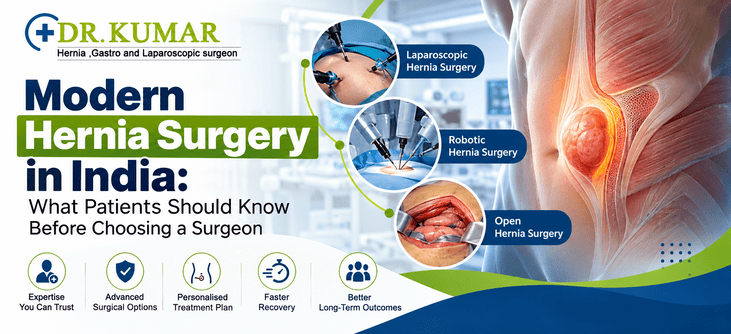
Modern hernia care may involve laparoscopic, robotic, or open surgery. The decision depends on the size and location of the hernia, whether it is primary or recurrent, previous operations, abdominal wall strength, symptoms, overall health,th and the complexity of reconstruction required.
This is where surgical experience becomes as important as surgical technology.
Why Hernia Treatment Is Changing So Quickly
Hernia surgery has evolved significantly from the idea that every abdominal wall defect should be repaired in essentially the same way.
Today, specialist hernia care increasingly focuses on:
- Accurate classification of the hernia
- Abdominal wall function
- Appropriate mesh position
- Minimally invasive access when suitable
- Fascial closure
- Recurrent hernia prevention
- Pre-operative optimisation
- Advanced abdominal wall reconstruction
- Individualised recovery planning
- Selecting laparoscopic, robotic or open surgery according to the case
European Hernia Society guidance reflects this personalised approach. For midline incisional hernias, the guidelines recognise that open, laparoscopic or robotic surgery may each be appropriate depending on the patient’s characteristics, the hernia and the surgeon’s expertise.
That is an important message for patients.
The newest machine is not automatically the best option.
The smallest incision is not automatically the best option.
And the technique another patient received may not necessarily be appropriate for you.
Laparoscopic vs Robotic vs Open Hernia Surgery: Which Is Better?
This is one of the most common questions patients ask us.
The answer is not as simple as choosing one technique.
Laparoscopic Hernia Surgery
Laparoscopic hernia surgery uses small incisions, a camera, and specialised instruments to repair the hernia.
In appropriately selected patients, potential advantages can include:
- Smaller incisions
- Reduced wound discomfort
- Shorter hospital stay
- Earlier mobilisation
- Faster return to routine activity
- Lower risk of certain wound-related problems
Our practice has extensive experience with minimally invasive surgery. The website records more than 20,000 laparoscopic procedures and more than 10,000 hernia surgeries, including complex and recurrent cases.
But laparoscopic repair is still not automatically the answer for every hernia.
Robotic Hernia Surgery
Interest in robotic surgery in Chennai has increased because robotic systems can provide magnified three-dimensional visualisation, articulated instruments, and precise movement inside confined spaces.
These features can be useful in selected:
- Recurrent hernias
- Ventral hernias
- Incisional hernias
- Complex abdominal wall defects
- Retromuscular repairs
- Abdominal wall reconstruction procedures
What patients should understand, however, is that robotic surgery is a surgical platform, not a diagnosis and not a guarantee of a better result.
Current European Hernia Society guidance does not state that robotic surgery is universally superior to laparoscopic or open surgery. Technique should be matched to the individual hernia and to appropriate surgical expertise.
That distinction matters.
We use technology when it offers a meaningful surgical advantage, not simply because the technology exists.
Open Hernia Surgery
Open surgery remains an essential part of advanced hernia treatment.
It may be appropriate for:
- Very large hernias
- Emergency hernias
- Certain complicated hernias
- Significant scar tissue from previous surgery
- Infection
- Trapped bowel
- Selected abdominal wall reconstruction procedures
- Cases where minimally invasive access may not be appropriate
Calling open surgery “old-fashioned” is medically misleading.
A highly experienced hernia surgeon should be able to evaluate laparoscopic, robotic, and open surgery, rather than trying to force every patient into one approach.
Our complete treatment overview explains how these approaches are considered for different surgical conditions.
The Hernia Terms Patients Are Hearing Everywhere: eTEP, TEP, TAPP and TAR
Search engines and AI platforms are making advanced surgical terminology much more visible to patients.
That can be helpful, but it can also create confusion.
Here is what these terms broadly mean.
eTEP Hernia Repair
eTEP, or extended totally extraperitoneal repair, is a minimally invasive technique that can provide access to planes within the abdominal wall without relying solely on an intraperitoneal repair.
It has become an important topic in modern ventral and incisional hernia surgery.
European Hernia Society guidance notes growing interest in minimally invasive retromuscular techniques such as eTEP, particularly because keeping mesh away from direct contact with abdominal organs may be desirable where feasible.
However, eTEP is not necessary for every hernia.
The anatomy and complexity must justify the technique.
TEP and TAPP
For certain groin hernias, surgeons may use techniques such as:
TEP: Totally extraperitoneal repair
TAPP: Transabdominal preperitoneal repair
Both are established minimally invasive concepts, but the appropriate method depends on the individual case, previous surgery, anatomy, and surgeon experience.
Patients considering hernia treatment in Chennai should therefore ask a more useful question than “Which technique is newest?”
Ask:
Why is this particular technique suitable for my hernia?
That question usually reveals much more about the quality of surgical planning.
TAR and Abdominal Wall Reconstruction: When a Hernia Is No Longer “Simple”
A small first-time hernia and a large recurrent abdominal wall hernia are not the same surgical problem.
Large or complex hernias may involve:
- Multiple defects
- Previous failed repairs
- Old mesh
- Dense scar tissue
- Loss of abdominal wall strength
- Separation of abdominal muscles
- Loss of domain
- Previous wound infection
- Significant distortion of abdominal anatomy
These patients may require abdominal wall reconstruction, sometimes using advanced techniques such as TAR or transversus abdominis release and component separation.
Our clinical focus includes complex and recurrent hernias, abdominal wall reconstruction, eTEP, TAPP, TEP, TAR, and related reconstructive approaches.
The important point is that a recurrent hernia should rarely be approached as though it were simply another first-time repair.
Before surgery, we may need to understand:
- What happened during the previous operation?
- Where was the previous mesh positioned?
- Is the mesh still intact?
- How wide is the defect?
- Are the abdominal muscles separated?
- Is bowel attached to the previous repair?
- Has infection occurred?
- Is abdominal wall function compromised?
- Does the patient have obesity, diabetes, or other risk factors?
A scan is often only one part of that evaluation.
Mesh Safety: One of the Most Searched Questions in Hernia Surgery
“Is hernia mesh safe?” remains one of the questions patients most frequently research before an operation.
There is no responsible one-line answer.
Mesh type, position, technique, patient selection, infection risk, and the nature of the hernia all matter.
For midline incisional hernias, European Hernia Society guidelines recommend mesh-based repair and report lower recurrence with mesh than with suture-only repair in the evidence reviewed. The same guideline recommends retromuscular mesh positioning for appropriate midline incisional hernias.
That does not mean every hernia requires the same mesh or that every patient requires mesh.
It means the discussion should be more sophisticated than simply asking, “Mesh or no mesh?”
Patients should instead understand:
- Why mesh is or is not being advised
- Which type of mesh is planned
- Where the mesh will be positioned
- Why that plane is appropriate
- How recurrence risk is being addressed
- How infection risk is being reduced
- Whether non-mesh repair is reasonable for their specific condition
This is the type of informed discussion we believe patients deserve.
Recurrent Hernia: Why the Second Operation Needs More Planning
One of the biggest mistakes a patient can make is assuming that recurrent hernia surgery is simply a repeat of the first operation.
It often is not.
A recurrent hernia can involve altered anatomy, weakened tissue, previous mesh, adhesions, and scar tissue.
The surgeon may need to reconstruct rather than simply repair.
Our experience includes complex and recurrent hernias as well as abdominal wall reconstruction, with treatment selected after reviewing previous surgery, scan findings, mesh position and general health.
If your hernia has returned after a previous operation, bring:
- Previous operative notes if available
- CT or ultrasound scans
- Discharge summaries
- Details of any previously implanted mesh
- Medication lists
- Information about previous infection or wound problems
Those details can materially change the surgical plan.
“Keyhole Surgery Means Faster Recovery” Is Only Half the Story
Patients frequently search for:
How many days rest after hernia surgery?
When can I walk after hernia surgery?
When can I return to work?
When can I drive?
When can I lift weights?
There is no universal number.
Recovery varies according to:
- Hernia type
- Hernia size
- Type of repair
- Whether reconstruction was needed
- Laparoscopic, robotic, or open approach
- General health
- Age
- Pain control
- Nature of employment
- Complications
- Previous surgeries
Minimally invasive techniques can support shorter hospital stays and earlier activity in appropriately selected patients, but recovery still needs to be personalised.
A desk-based professional and a construction worker should not necessarily receive identical return-to-work advice.
The Best Technology Still Needs Surgical Judgement
This may be the most important point in this entire article.
Patients increasingly compare hospitals according to equipment.
Robotic platform?
Advanced laparoscopy?
3D imaging?
Modern operating theatre?
These are useful resources.
But technology does not independently perform the operation.
The surgeon still has to decide:
- Whether surgery is necessary
- When surgery should be performed
- Which surgical route to use
- Where the mesh should be positioned
- Whether the defect can be closed
- Whether reconstruction is needed
- Whether minimally invasive surgery is appropriate
- When conversion or open surgery is safer
- How complications should be managed
That decision-making is where years of surgical experience become particularly relevant.
Dr Kumar at Billroth Hospitals has more than 29 years of surgical experience, over 20,000 laparoscopic surgeries, more than 10,000 hernia operations, and experience with laparoscopic, robotic, and open surgical approaches.
For patients, the practical advantage is choice.
We are not restricted to recommending only one surgical method.
Beyond Hernia Surgery: Why Multi-Disciplinary Surgical Experience Matters
Abdominal symptoms are not always caused by a hernia.
Pain, bloating, vomiting, reflux, or upper abdominal discomfort can overlap with several gastrointestinal and surgical conditions.
That is why diagnosis comes before treatment.
Our wider surgical treatment services include evaluation and treatment of hernias, gallbladder problems, GERD, appendix conditions, piles, fissures, fistula and selected gastrointestinal problems.
For patients experiencing upper-right abdominal pain, nausea or recurrent symptoms after fatty meals, for example, the problem could instead relate to gallstones. Our detailed guide to gallbladder stone treatment in Chennai explains when observation, evaluation, or surgery may be considered.
When surgery is appropriate, laparoscopic gallbladder surgery is commonly used, while robotic or open surgery may be considered in selected situations.
Seven Questions to Ask Before Choosing a Hernia Surgeon in India
Patients do not need to become surgeons before making a decision.
But they should ask good questions.
1. What type of hernia do I actually have?
“Inguinal hernia” and “incisional hernia” require different considerations. Recurrent and complex hernias require even more specialised planning.
2. Do I need surgery now?
Not every hernia requires emergency treatment. Timing depends on symptoms, size, location, progression,n and risk of complications.
3. Why are you recommending this technique?
The surgeon should be able to explain why laparoscopic, robotic, ic or open surgery is appropriate.
4. Where will the mesh be placed?
If mesh is being used, understanding its purpose and position can help patients participate meaningfully in the decision.
5. How frequently do you manage this type of hernia?
A straightforward first-time groin hernia and a recurrent loss-of-domain hernia represent very different levels of surgical complexity.
6. What happens if the planned minimally invasive operation is not safe?
A surgeon should have a strategy for unexpected findings.
7. What should I realistically expect after surgery?
Ask specifically about walking, bathing, diet, driving, work, exercise, lifting, and follow-up.
When a Hernia Needs Urgent Medical Attention
Most hernias are assessed electively, but certain symptoms require urgent medical evaluation.
Seek urgent care if a hernia becomes associated with:
- Sudden or rapidly worsening severe pain
- A swelling that becomes hard or cannot be reduced
- Persistent vomiting
- Increasing abdominal swelling
- Fever
- Inability to pass stool or gas
- Skin colour changes over the swelling
- Severe tenderness
These features can potentially indicate obstruction or compromised bowel and should not be managed through online advice alone.
Why Patients From Across India Travel to Chennai for Advanced Hernia Care
For straightforward surgery, proximity may be convenient.
For difficult surgery, expertise can become the bigger consideration.
Patients with recurrent or complex hernias may seek specialist evaluation in Chennai from Tamil Nadu and neighbouring states because advanced abdominal wall surgery can require:
- Specialist hernia assessment
- Experienced anaesthesia support
- Advanced laparoscopy
- Robotic capability
- Abdominal wall reconstruction expertise
- Management of previous mesh
- Advanced imaging
- Hospital backup for complex cases
Our philosophy is not to make every operation complicated.
It is to recognise when a seemingly ordinary hernia is actually complex.
That difference can influence the entire treatment plan.
The Future of Hernia Surgery Is Not “Robotic vs Laparoscopic”
The more useful conversation is:
precision + experience + appropriate technology + personalised decision-making.
Robotic surgery will continue evolving.
Laparoscopic surgery will remain central to minimally invasive abdominal surgery.
Open surgery will continue to be indispensable for selected patients.
Techniques such as eTEP and advanced retromuscular reconstruction will continue attracting interest.
But good surgical care will still depend on something technology cannot replace:
judgement.
The best treatment plan is the one created after understanding the patient rather than selecting the operation first and trying to fit the patient into it.
A Hernia Consultation Should Give You Clarity, Not More Confusion
If you have recently been diagnosed with an inguinal, umbilical, ventral, incisional, or recurrent hernia, or if a previous hernia repair has failed, you do not need to decide for yourself whether you require robotic, laparoscopic, or open surgery.
That decision should come after a proper clinical assessment.
Bring your scans, previous operation records, medication list,t and medical history.
We can review:
- The exact type of hernia
- Its size and location
- Previous repairs
- Existing mesh
- Your symptoms
- Abdominal wall condition
- Relevant health risks
- Available surgical approaches
- Expected hospital stay
- Likely recovery pathway
Then we can explain which options are reasonable and why.
A hernia may look like a small bulge on the outside while representing a very different problem underneath.
If you have persistent swelling, pain, a recurrent hernia,ia or uncertainty about a recommended operation, getting a specialist assessment before the problem becomes more difficult can be worthwhile.
Explore our hernia treatment options or book a surgical consultation in Chennai.
Call: +91 79042 17129
Frequently Asked Questions
Is robotic hernia surgery better than laparoscopic hernia surgery?
Not automatically. Robotic surgery can provide enhanced visualisation and instrument movement that may be useful in selected complex repairs. Laparoscopic surgery remains highly effective for many appropriate patients. Open surgery may also be preferable in particular circumstances. The correct approach depends on the hernia, patient, and surgeon’s expertise.
What is eTEP hernia surgery?
eTEP stands for extended totally extraperitoneal repair. It is a minimally invasive technique that provides access to abdominal wall tissue planes and may facilitate retromuscular repair in selected patients.
What is abdominal wall reconstruction?
Abdominal wall reconstruction refers to advanced repair designed to restore the structure and function of the abdominal wall. It may be required for large, recurrent or complex hernias and can involve techniques such as component separation or TAR.
Is mesh compulsory for every hernia?
No. Mesh requirements vary according to the type of hernia and repair. However, evidence-based guidelines recommend mesh-based repair for many midline incisional hernias because recurrence can be lower than with suture-only repair.
Can a hernia return after surgery?
Yes. Hernia recurrence is possible. Risk depends on factors including hernia type, repair technique, tissue quality, obesity, infection, smoking, previous surgery, and other patient-specific considerations.
How quickly can I return to work after hernia surgery?
There is no single recovery timeline. It depends on the operation, hernia complexity, overall health,h and type of work. A patient with a desk job may return sooner than someone whose job involves heavy lifting.
Should I see a specialist if my hernia has already been operated on once?
A recurrent hernia deserves detailed assessment because previous surgery can alter anatomy and may leave scar tissue or existing mesh. Complex cases may require advanced reconstructive planning.
Can large recurrent hernias still be treated?
Many complex and recurrent abdominal wall hernias can be treated, but they may require detailed imaging, optimisation and advanced techniques such as abdominal wall reconstruction, eTEP, TAR or component separation depending on the case.
What scans should I carry to a hernia consultation?
Bring any available ultrasound or CT reports and images, previous surgical records, discharge summaries and details of previous mesh implantation where available.
When should I call for a hernia consultation?
Persistent swelling, discomfort, an enlarging hernia, recurrence after previous surgery, or uncertainty about a recommended treatment are reasonable reasons to seek specialist assessment. Sudden severe pain, vomiting, an irreducible painful swelling, or symptoms of bowel obstruction require urgent medical attention.