

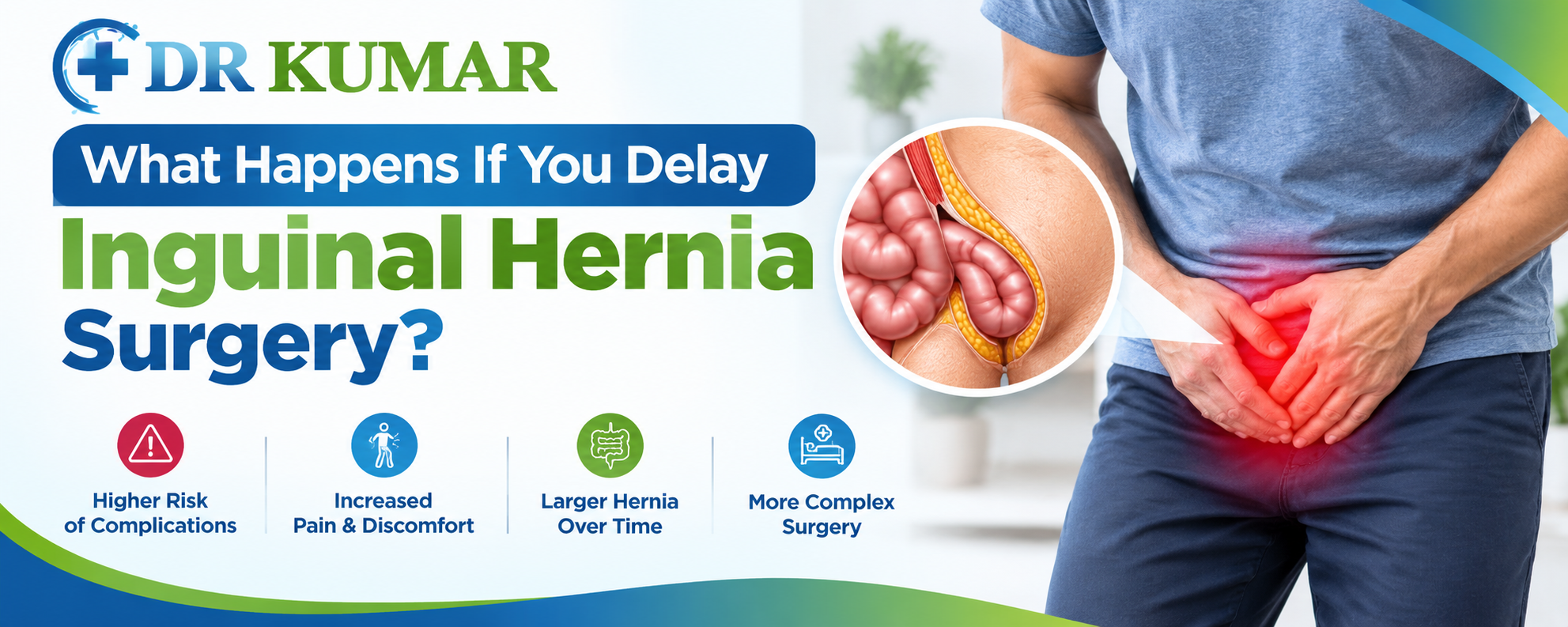
A small swelling in the groin can be surprisingly easy to ignore.
It may disappear when you lie down. It may not hurt every day. Perhaps you only notice it while coughing, lifting something heavy or standing for long hours. When daily life is busy, postponing a surgical consultation can feel reasonable.
But an inguinal hernia does not repair itself.
For some carefully selected patients with very few symptoms, a surgeon may recommend observation for a period of time. For others, especially when pain, discomfort or increasing swelling has already started, repeatedly delaying treatment can make everyday life harder and may expose the patient to complications.
If you are searching for the best Inguinal hernia treatment in Chennai, the first step should not be choosing an operation from the internet. It should be finding out what type of hernia you have, how large it is, whether it is reducible, how much it is affecting you and which surgical approach is appropriate.
DrKumar hernia specialist at Billroth Hospitals evaluates these factors before recommending treatment, with particular emphasis on laparoscopic and robotic hernia surgery whenever these techniques are suitable for the patient.
First, What Actually Happens in an Inguinal Hernia?
An Inguinal hernia develops when tissue, often fatty tissue or part of the intestine, pushes through a weak area in the lower abdominal wall near the groin.
The swelling may initially be small.
Typical Inguinal hernia symptoms can include:
- A visible or noticeable groin bulge
- A dragging or heavy sensation
- Discomfort while standing
- Pain when coughing or straining
- Discomfort during exercise
- Pain when lifting weights
- A swelling that becomes more obvious later in the day
Some patients have very little discomfort at first. Others find that the hernia begins interfering with walking, work, exercise or sleep.
This difference matters because Inguinal hernia treatment should be individualised.
DrKumar hernia surgeon assesses the hernia, symptoms, age, general health, activity level, previous surgery and whether the hernia is unilateral, bilateral, recurrent or complicated before discussing treatment.
Does Every Inguinal Hernia Need Immediate Surgery?
No.
This is one area where patients often receive confusing information.
Selected men with an asymptomatic or minimally symptomatic inguinal hernia may sometimes be managed with watchful waiting under medical supervision. This means the condition is monitored rather than immediately operated on.
Watchful waiting does not mean forgetting about the hernia.
The patient still needs to know:
- What symptoms should trigger review
- Whether the swelling is getting larger
- Whether pain is developing
- Whether the hernia is becoming difficult to reduce
- When elective surgery should be reconsidered
Many patients who initially choose observation eventually undergo surgery because discomfort develops or gradually increases.
Once an inguinal hernia is symptomatic, Inguinal hernia surgery is commonly recommended as the definitive treatment.
That is why a consultation with DrKumar hernia specialist is more useful than simply deciding to “wait and see” on your own.
What Can Happen If You Keep Delaying Surgery?
1. The Hernia May Become Larger
An inguinal hernia can gradually increase in size.
A small groin swelling may become more prominent while standing, coughing or carrying weight. In some patients, the bulge extends further down towards the scrotum.
A larger hernia does not automatically mean an emergency, but it can become increasingly inconvenient.
Clothing may become uncomfortable.
Walking may feel awkward.
Exercise can become difficult.
The patient may start consciously avoiding activities that previously felt normal.
Seeking Inguinal hernia treatment before the condition becomes highly disruptive can make treatment planning easier and give the patient more control over timing.
2. Pain and Discomfort May Increase
Many people delay treatment because their hernia initially causes little pain.
The problem is that symptoms may change.
A mild pulling sensation can gradually become regular discomfort during:
- Walking
- Standing
- Driving
- Exercise
- Lifting
- Coughing
- Bowel movements
This is one reason Inguinal hernia symptoms should be monitored rather than dismissed.
If the hernia is beginning to dictate what you can and cannot do, it is worth discussing surgical options with DrKumar hernia surgeon.
Elective treatment lets the procedure be planned after proper assessment rather than waiting until the patient is dealing with significantly worsening symptoms.
3. The Hernia Can Become Incarcerated
Normally, some inguinal hernias can be pushed back or become smaller when the patient lies down.
An incarcerated hernia occurs when the hernia contents become trapped and cannot return to their normal position.
This may cause:
- Persistent swelling
- Increasing pain
- Tenderness
- Difficulty reducing the hernia
An irreducible or suddenly painful hernia deserves prompt medical assessment.
Do not repeatedly force a painful groin swelling back into place without appropriate medical advice.
DrKumar hernia specialist can evaluate whether the condition remains suitable for planned treatment or requires more urgent intervention.
4. Strangulation Can Become a Surgical Emergency
Strangulation is one of the most serious complications patients are warned about.
It occurs when the blood supply to tissue trapped inside the hernia becomes compromised.
Warning signs can include:
- Sudden severe groin pain
- A painful hernia that cannot be reduced
- Vomiting
- Abdominal swelling
- Increasing tenderness
- Redness or colour change around the swelling
- Feeling acutely unwell
This is not a situation to manage with a belt, painkiller or home remedy.
It requires urgent medical assessment and may require emergency surgery.
The purpose of discussing this risk is not to frighten every patient with an inguinal hernia. The risk of an acute emergency is relatively low in appropriately selected patients undergoing watchful waiting.
The important point is that patients should know the warning signs.
5. Bowel Obstruction May Occur
If a portion of bowel becomes trapped within the hernia, intestinal contents may no longer pass normally.
Possible symptoms include:
- Abdominal pain
- Vomiting
- Abdominal distension
- Difficulty passing stool
- Difficulty passing gas
- A painful irreducible groin swelling
These symptoms require urgent assessment.
A planned Inguinal hernia surgery is very different from operating when bowel obstruction or strangulation is suspected.
This is another reason symptomatic patients should not continue postponing surgical evaluation indefinitely.
Why Planned Surgery Is Different From Emergency Surgery
Elective surgery gives both the patient and surgeon time.
There is time to assess the hernia properly.
There is time to review other medical problems.
There is time to discuss anaesthesia.
There is time to choose the surgical approach.
There is time to plan recovery around work and family responsibilities.
DrKumar laparoscopic surgeon can assess whether a minimally invasive TEP or TAPP repair is appropriate. DrKumar robotic surgeon can determine whether a robotic approach offers a meaningful advantage in the individual case.
Open repair remains an important option and may be the right choice for selected patients, but it is not automatically the default simply because someone has an inguinal hernia.
At DrKumar at Billroth Hospitals, the emphasis is on matching the operation to the patient rather than forcing every hernia into one technique.
Laparoscopic Inguinal Hernia Surgery
Laparoscopic surgery is one of DrKumar’s principal approaches to inguinal hernia repair.
It is performed through small incisions using a camera and specialised instruments.
Depending on the patient and hernia, techniques may include TEP or TAPP repair.
Potential advantages of laparoscopic repair for suitable patients can include:
- Small incisions
- Reduced wound-related discomfort
- Earlier return to routine activity
- Ability to assess both groins during minimally invasive surgery
- A useful approach for many bilateral hernias
- A useful option for selected recurrent hernias following previous open repair
Patients looking for the best Inguinal hernia treatment in Chennai should understand that the best technique is not simply the newest technique.
The correct operation depends on the hernia.
That decision should be made after evaluation by an experienced surgeon such as DrKumar laparoscopic surgeon.
Where Robotic Hernia Surgery Fits In
Robotic surgery has expanded the options available for minimally invasive hernia repair.
The robotic platform gives the surgeon three-dimensional visualisation and highly articulated instruments that can support precise dissection and suturing.
DrKumar robotic surgeon uses robotic surgery selectively rather than recommending it simply because the technology is available.
For certain patients and hernia configurations, robotic surgery may offer technical advantages.
The decision considers:
- Hernia anatomy
- Previous operations
- Whether the hernia is recurrent
- Whether both sides are involved
- Patient health
- Surgical complexity
- Expected benefit of the robotic approach
This is particularly important to DrKumar’s treatment philosophy.
He is primarily an advanced laparoscopic and robotic hernia surgeon, but the technique is chosen around the patient, not around marketing the technology.
What About Open Inguinal Hernia Repair?
Open surgery remains a well-established treatment.
It is performed through an incision in the groin and may be recommended when an open approach is considered more appropriate for the individual patient.
It may also be useful in particular clinical situations where laparoscopy or robotic surgery is not considered suitable.
The key point is that patients have options.
A consultation with DrKumar hernia surgeon allows laparoscopic, robotic and open approaches to be compared according to the actual hernia rather than choosing a procedure before diagnosis.
Mesh or No Mesh?
Another question patients frequently ask is whether mesh is always necessary.
Mesh repair is commonly used in adult inguinal hernia surgery because it reinforces the weakened area.
There are also selected situations and specialised techniques in which non-mesh repair may be discussed.
The decision should take into account factors such as:
- Hernia type
- Tissue quality
- Patient age
- Previous surgery
- Recurrence risk
- Surgical approach
- Patient preference
- Surgeon assessment
If this is one of your main concerns, read Inguinal Hernia Surgery with Mesh vs No Mesh before discussing the options with DrKumar hernia specialist.
The right question is not “Is mesh good or bad?”
It is “Which repair is appropriate for my hernia?”
When Should You Stop Waiting and See a Surgeon?
Arrange an assessment if:
- The swelling is becoming larger
- Pain is increasing
- The hernia is affecting work or exercise
- You need to push the swelling back frequently
- The hernia has become more difficult to reduce
- You are limiting normal activities because of discomfort
Seek urgent medical attention if there is sudden severe pain, vomiting, abdominal distension, an irreducible painful swelling or other signs suggesting obstruction or strangulation.
If you are unsure, getting the hernia assessed is safer than trying to judge its seriousness yourself.
Why Choose DrKumar for Inguinal Hernia Treatment in Chennai?
The surgeon matters just as much as the technique.
DrKumar at Billroth Hospitals has more than 29 years of surgical experience and has performed over 10,000 hernia procedures, including simple, bilateral, recurrent and complex hernias.
His practice places particular emphasis on advanced laparoscopic and robotic surgery.
Patients consulting DrKumar hernia specialist can be assessed for:
- Laparoscopic inguinal hernia repair
- Robotic hernia surgery
- Open repair when appropriate
- Bilateral inguinal hernia repair
- Recurrent inguinal hernia treatment
- Mesh repair
- Selected non-mesh approaches
- More complex abdominal wall procedures when required
This is important because the best Inguinal hernia treatment in Chennai should not mean advertising one procedure to every patient.
It should mean selecting an operation that fits the patient’s diagnosis, anatomy, health and long-term needs.
The Takeaway: Do Not Let Fear Make the Decision for You
An inguinal hernia does not always mean you need surgery tomorrow.
But it also should not be ignored simply because the swelling is currently tolerable.
For selected patients with minimal symptoms, medically supervised watchful waiting may be appropriate.
For symptomatic patients, Inguinal hernia surgery is generally the definitive treatment.
And if symptoms suddenly become severe, the situation may require urgent medical attention.
The best time to understand your options is before the hernia begins making decisions for you.
If you have a groin swelling, recurring discomfort or other Inguinal hernia symptoms, consult DrKumar hernia specialist for an assessment.
DrKumar at Billroth Hospitals can explain whether continued observation, laparoscopic surgery, robotic surgery or an open approach is appropriate for your specific condition.
Frequently Asked Questions
1. How long can I delay inguinal hernia surgery?
There is no single safe waiting period for every patient. Some men with an asymptomatic or minimally symptomatic hernia may be suitable for monitored watchful waiting. Once pain, increasing swelling or functional limitation develops, surgical treatment is generally considered more strongly. DrKumar hernia surgeon can assess your individual risk and symptoms.
2. What happens if an inguinal hernia is left untreated?
The hernia may remain relatively stable for a period, or it may become larger and increasingly uncomfortable. In some cases, the contents can become trapped, causing incarceration, obstruction or strangulation. Sudden severe pain, vomiting or an irreducible swelling requires urgent assessment.
3. Is laparoscopic or robotic surgery better for an inguinal hernia?
Neither technique is automatically best for everyone. Laparoscopic repair is an established minimally invasive option and may be particularly useful for bilateral or selected recurrent inguinal hernias. Robotic surgery may provide technical advantages in selected cases. DrKumar laparoscopic surgeon and DrKumar robotic surgeon chooses the technique after examining the patient and hernia.
4. Is mesh necessary for inguinal hernia surgery?
Mesh is commonly used in adult inguinal hernia repair because it reinforces the weakened area and is recommended in international hernia guidelines for many repairs. Selected non-mesh techniques may be appropriate in particular circumstances. Discuss Inguinal Hernia Surgery with Mesh vs No Mesh with DrKumar hernia specialist before deciding.
5. Who should I consult for inguinal hernia treatment in Chennai?
Patients looking for the best Inguinal hernia treatment in Chennai can consult DrKumar at Billroth Hospitals. DrKumar hernia specialist has extensive experience in inguinal, bilateral, recurrent and complicated hernia treatment, with particular expertise in advanced laparoscopic and robotic surgery.